


AI-Designed Stretchable 3D Printing Material Could Advance Soft Robotics and Wearable Devices
 02 September 2026 04:46 PM
Summary: Researchers have developed an AI-designed 3D-printing material that stretches more than six times its original length while remaining easy to manufacture, opening new possibilities for soft robots, wearable electronics, and custom medical devices.
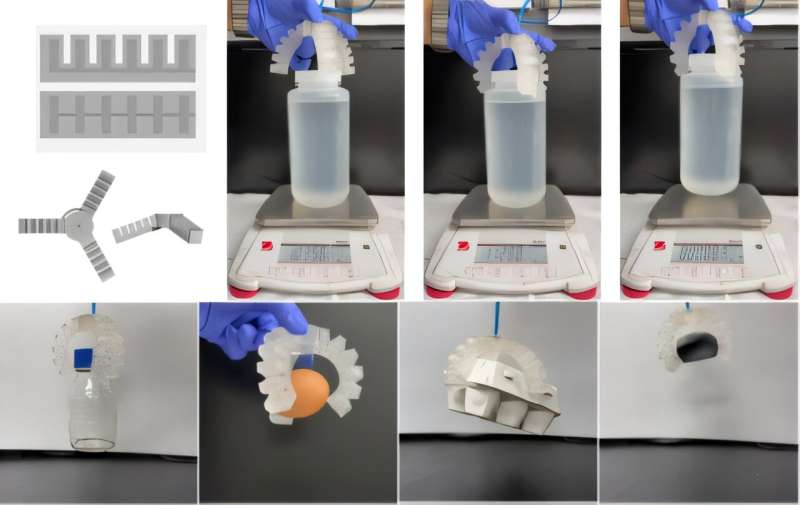
Soft robotic gripper fabricated using the newly developed material.
A research team from South Korea has unveiled an AI-designed stretchable 3D-printing material that combines exceptional elasticity with reliable printability, addressing one of the biggest challenges in advanced manufacturing. The breakthrough, published in Nature Communications, could accelerate innovation in soft robotics, wearable technology, biomedical devices, and additive manufacturing.
The new material was developed using an artificial intelligence-driven materials discovery framework that identifies optimal chemical formulations based on performance requirements. Researchers trained machine-learning models using experimental data from both easily printable materials and highly viscous formulations that are traditionally difficult to process.
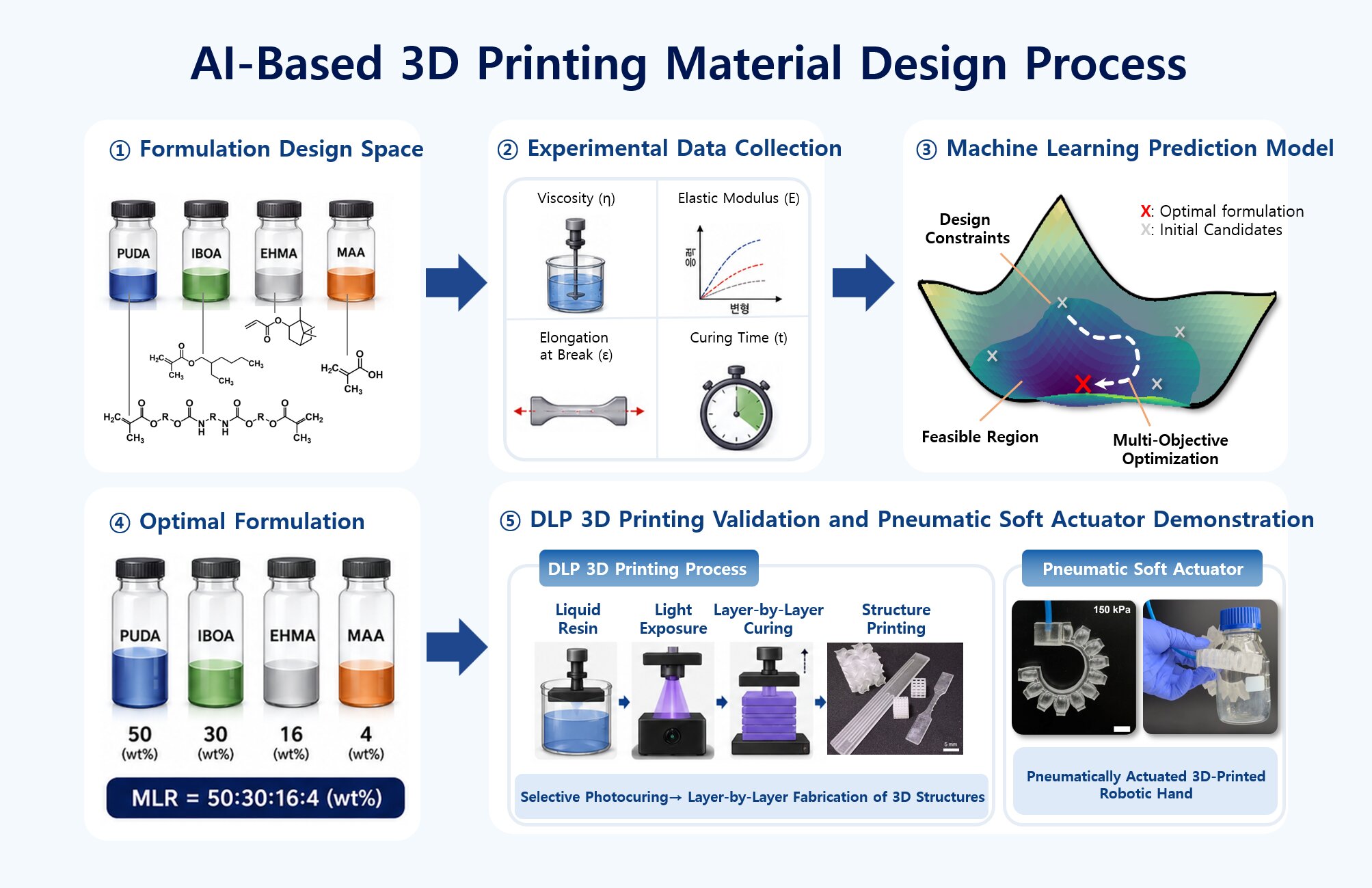
AI-based material design framework proposed in this study and its application to soft robotics.
The challenge lies in balancing two conflicting properties. Materials that are highly stretchable and durable often become too thick for Digital Light Processing (DLP) 3D printing, while materials optimized for printing typically sacrifice flexibility and strength. By analyzing extensive datasets linking material composition to mechanical and printing characteristics, the AI system identified a formulation that achieves both.
Tests showed that the resulting material can be stretched to more than six times its original length without tearing while maintaining compatibility with commercial DLP 3D printers. This combination enables the production of complex, soft structures that were previously difficult to manufacture efficiently.
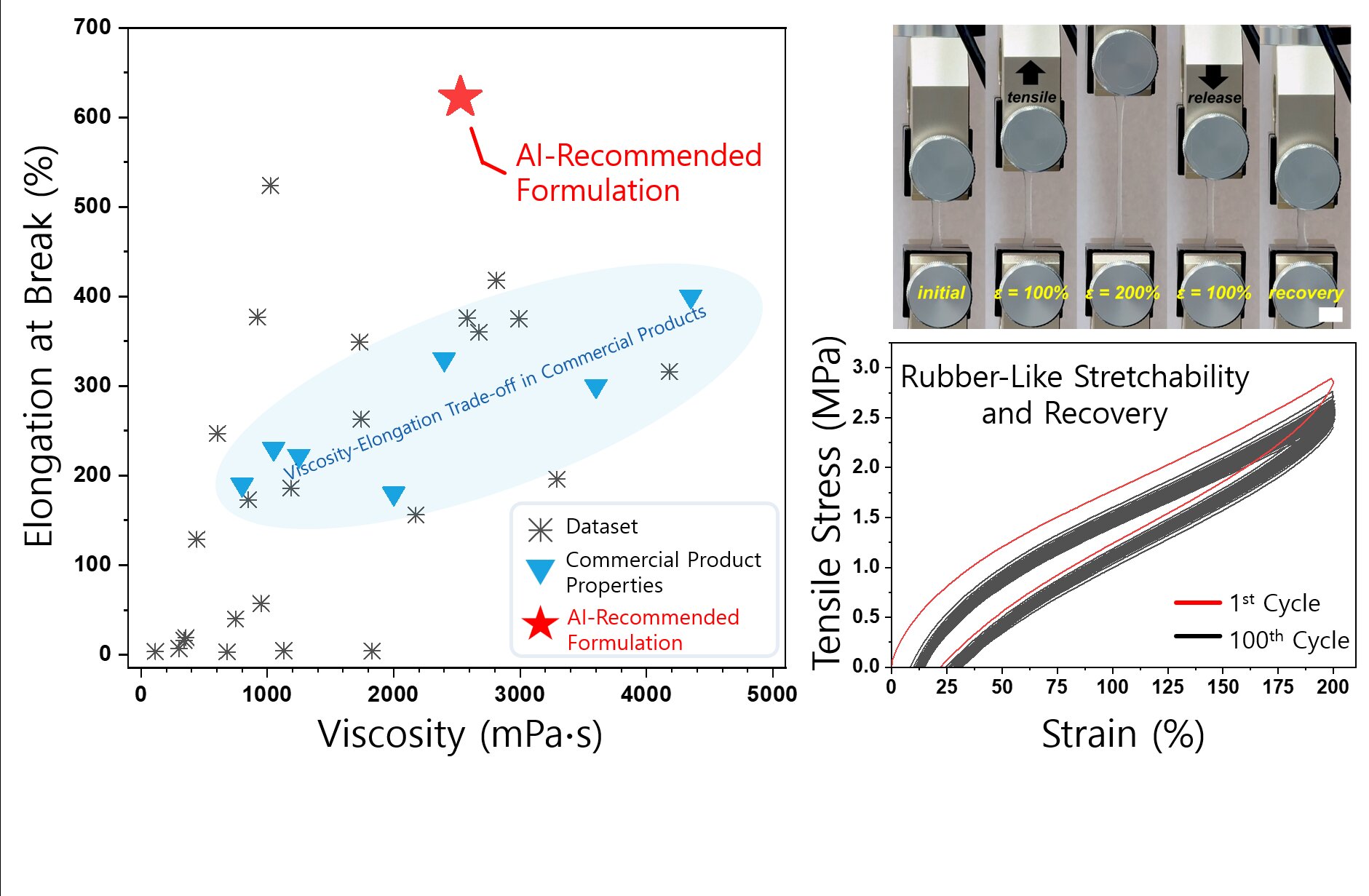
AI-based design and mechanical properties of the 3D-printing material.
To demonstrate real-world applications, the researchers fabricated a soft robotic actuator capable of bending and moving similarly to a human finger when inflated with air. Multiple actuators were then assembled into a soft robotic gripper that successfully lifted a 1-kilogram water bottle and delicately handled objects with different shapes and fragility levels, including eggs, glass bottles, and computer peripherals.
Beyond a single material innovation, the study highlights how AI-powered materials design can dramatically reduce the trial-and-error process traditionally required for developing advanced polymers. Instead of experimentally testing countless combinations, researchers can use machine learning to predict promising candidates before laboratory validation.
As demand grows for next-generation soft robotic hands, flexible wearable devices, personalized healthcare products, and advanced 3D-printing materials, the AI-assisted approach could significantly shorten development cycles and accelerate commercialization across multiple industries.