


Graphene Oxide SPR Sensor Detects Mercury, Lead, and Zinc in Water at Low Cost
 18 September 2026 02:46 PM
Summary: Researchers have designed a graphene oxide-enhanced SPR sensor capable of detecting trace mercury, lead, and zinc ions in water with high sensitivity while potentially reducing costs compared with conventional gold-based systems.
A research team from Universidad Técnica Particular de Loja, ESPOCH, the University of Calabria, and Ecotec University has developed a computer-optimized surface plasmon resonance (SPR) sensor that could enable low-cost detection of heavy metal contamination in water.
The proposed sensor uses a graphene oxide sensing layer deposited on an aluminum/aluminum oxide plasmonic structure supported by a borosilicate glass prism. The design targets the detection of mercury (Hg), lead (Pb), and zinc (Zn) ions—three contaminants linked to environmental pollution and public health risks.
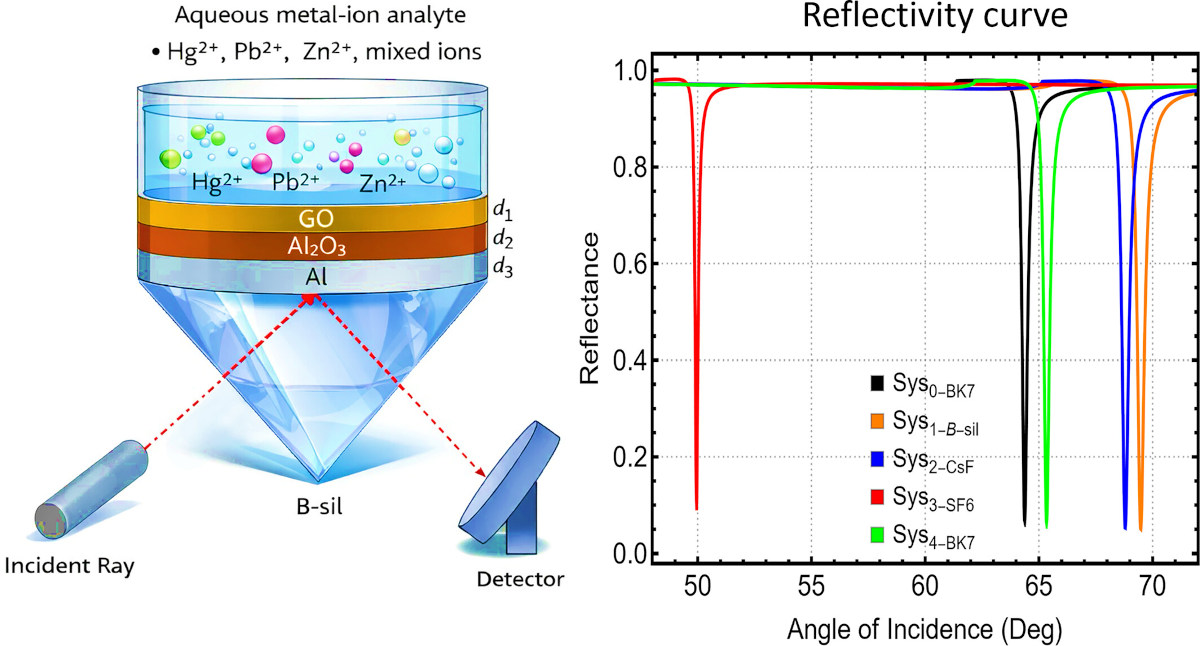
To identify the most effective sensing material, researchers compared graphene oxide, reduced graphene oxide, pristine graphene, and semiconducting single-walled carbon nanotubes. While some materials produced larger resonance shifts, they also significantly broadened the resonance signal, reducing measurement clarity. Graphene oxide delivered the best balance of sensitivity and signal quality, producing clear resonance responses suitable for trace detection.
The optimized configuration, featuring a 60 nm aluminum layer and a 32 nm aluminum oxide layer beneath the graphene oxide coating, achieved angular sensitivities of up to 338°/RIU and detection limits on the order of 10⁻⁵ RIU in simulations. The system was evaluated for individual metal ions as well as mixed mercury-lead and mercury-zinc contamination scenarios.
Researchers selected aluminum instead of gold to reduce material costs, while the aluminum oxide layer protects the metal from oxidation and helps tune the optical response.
The technology remains at the simulation stage and has not yet been fabricated or tested with real water samples. Future work will focus on experimental validation, improving ion selectivity through surface functionalization, and assessing performance under real-world conditions such as varying pH, temperature, and dissolved contaminants.