


Caltech Meta-Surface Chip Steers Light with Light in Just 74 Femtoseconds
 20 September 2026 06:04 PM
Summary: Caltech researchers have demonstrated an ultrafast photonic chip that uses one laser beam to steer another in just 74 femtoseconds, opening new possibilities for next-generation optical computing, communications, and sensing technologies.
Researchers at the California Institute of Technology (Caltech) have developed an ultrafast photonic device capable of steering a beam of light using another beam of light in only 74 femtoseconds, a breakthrough that could accelerate the development of optical computing, high-speed telecommunications, AI photonics, and advanced optical sensors.

The study, published in Nature Nanotechnology, introduces a new approach to all-optical beam steering that avoids the speed limitations of conventional electronic and liquid-crystal-based systems. Traditional light-modulation technologies rely on electronic transitions inside materials, which typically limit performance to picosecond or nanosecond timescales.
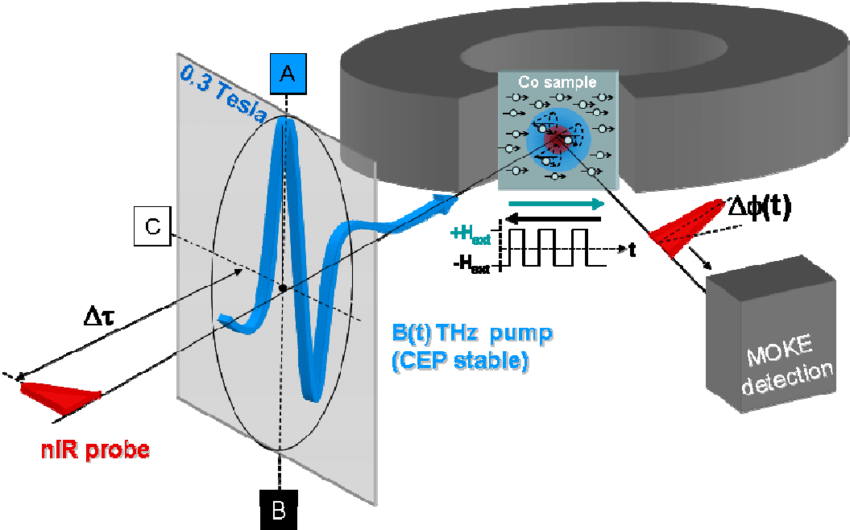
Instead, the Caltech team employed a powerful laser pulse, known as a pump beam, to temporarily modify the optical properties of a specially engineered meta-surface. A second probe beam passing through the material was then redirected according to the pump beam's projected pattern.
The technology is based on the optical Kerr effect, a phenomenon in which intense light briefly changes a material's refractive index. While the Kerr effect is normally too weak for practical beam steering, researchers amplified it using an ultrathin amorphous silicon meta-surface covered with nanoscale pillars.
Diagram
These nanoengineered structures trap and circulate light within the material for a longer period, significantly enhancing light–matter interaction. As a result, the device successfully redirected light by angles of up to 13 degrees while maintaining an ultrafast response time of just 74 femtoseconds.
Researchers found that the current speed limit is determined by the duration of the laser pulse rather than the material itself, suggesting that even faster optical control may be achievable in future designs.
The breakthrough could enable emerging applications in photonic computing, ultrafast optical communications, programmable meta-surfaces, spatial light modulation, time-varying optical materials, and next-generation quantum and AI hardware, where controlling light at unprecedented speeds is becoming increasingly important.