


AI and Robotics Power a Self-Driving Laboratory to Accelerate High-Temperature Coating Materials Discovery
 27 October 2026 05:38 PM
Summary: Researchers at the University of Nottingham have developed an AI-powered, robotic self-driving laboratory that automates material preparation, high-temperature sintering, and sample retrieval. By combining robotics with active learning, the platform accelerates the discovery of low-thermal-conductivity materials for aerospace thermal barrier coatings and other high-temperature applications.
Developing new materials for extreme environments often requires repeated formulation, sintering, and performance testing, making the process time-consuming and labor-intensive. A team at the University of Nottingham in the UK has built an autonomous laboratory that integrates AI and robotics to automate the entire experimental workflow, targeting high-temperature materials for aerospace and energy applications and improving the efficiency of materials discovery.
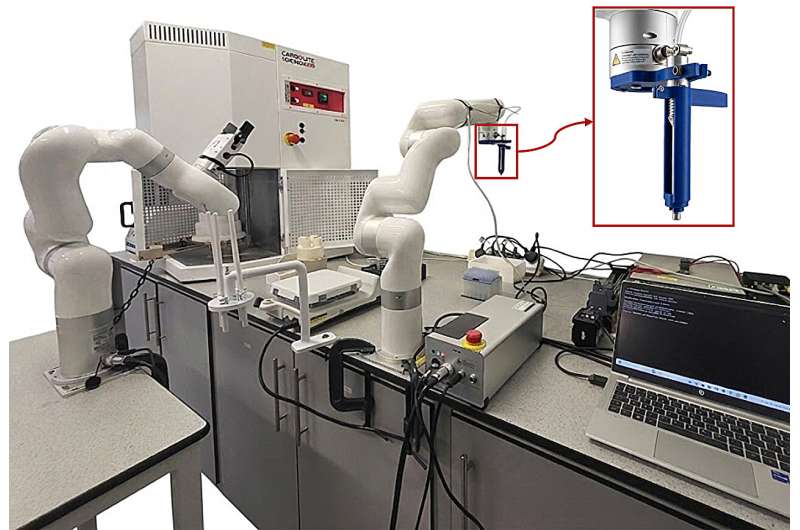
Traditional research into materials for extreme environments involves a lengthy cycle: researchers manually mix raw materials, prepare samples, process them in high-temperature furnaces, and retrieve them for performance testing. The University of Nottingham’s Centre for Excellence in Coatings and Surface Engineering (CE-CSE) has developed a system that transfers this entire experimental sequence to automated equipment.
The platform integrates two robotic arms, a dedicated liquid-dispensing system, laboratory equipment, and custom-developed control software. From precise weighing and mixing of chemical precursor solutions to high-temperature furnace processing, controlled cooling, and sample retrieval, each step is performed automatically. Its key innovation is the integration of active learning AI algorithms. By analyzing previous experimental data, the AI determines which material compositions should be tested next, avoiding the need to exhaustively explore every possible formulation. Using this approach, the team has identified several candidate materials with a pyrochlore crystal structure, a class of materials known for their low thermal conductivity and potential use in thermal barrier coatings for aircraft engines.
Thermal barrier coatings act as heat shields for high-temperature engine components, limiting heat transfer into the underlying materials. They are essential to aerospace engineering, where the development of materials with even lower thermal conductivity remains a major research priority. Although robotic automation is already used for individual laboratory tasks, integrating liquid preparation, sample handling, and high-temperature furnace processing into a reliable, continuous workflow presents significant technical challenges. Through repeated calibration and validation, the team achieved precise liquid dispensing across different reagents, connecting the entire process from precursor preparation to post-furnace sample retrieval.
Project lead Professor Tanvir Hussain said the self-driving laboratory could transform advanced materials research. The work addresses a major challenge in coordinating liquid handling with high-temperature processing, laying the groundwork for more intelligent experimental planning and optimization. Researcher Mohammadreza Lalegani Dezaki added that the system integrates previously separate laboratory operations into a coherent robotic workflow, enabling end-to-end automation of complex materials synthesis and establishing a foundation for reproducible, high-throughput materials research.
By reducing repetitive manual operations, the platform can minimize human error and improve experimental consistency while providing a practical pathway toward high-throughput materials discovery. The findings have been published in Engineering Applications of Artificial Intelligence.