


VicOne Discovers 28 Zero-Day Vulnerabilities in Physical AI Robotics Software
 02 November 2026 03:29 PM
Lead: Cybersecurity firm VicOne has identified 28 previously unknown zero-day vulnerabilities in software used across Physical AI robotics ecosystems, completing its initial AI-assisted security research in less than two days. The flaws affect widely used robotics development and simulation tools from Google, NVIDIA, Meta and other technology providers, raising concerns about robot safety from development to real-world deployment.
VicOne researchers used AI-assisted vulnerability analysis to examine software tools used to develop, train, simulate, test and operate robots. Initial assessments classify all 28 findings as zero-day vulnerabilities, meaning they were previously unknown and had no official patches at the time of discovery. The final number may change following vendor reviews and security assessments, while some vulnerabilities have yet to receive Common Vulnerabilities and Exposures (CVE) identifiers.
Approximately 75% of the identified vulnerabilities affect robotics development, training, simulation and validation pipelines. This highlights a security risk that extends beyond physical robots themselves: compromised supporting software could manipulate training datasets, modify AI models, falsify safety test results or interfere with commands sent to deployed machines.
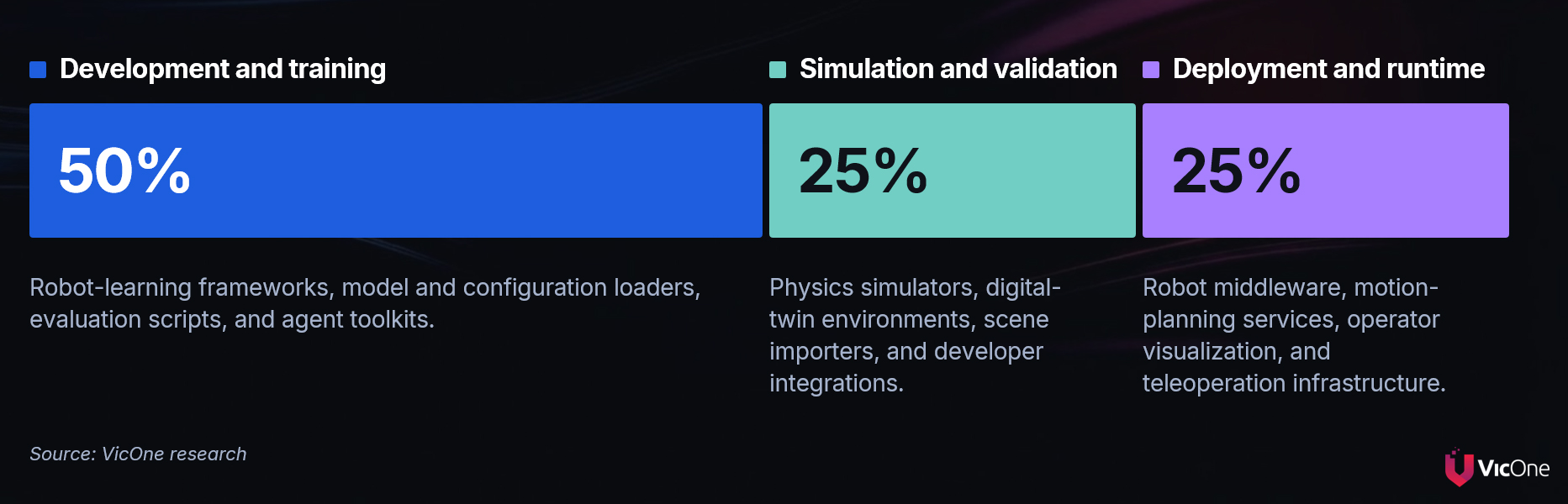
VicOne identified security risks across three major stages of the robotics lifecycle. During development and training, malicious files introduced through pre-trained models could alter training data or model parameters. Such tampering may remain undetected during routine checks, causing robots to behave unpredictably when encountering specific objects, environments or instructions after deployment.
In simulation and validation, attackers could exploit compromised robot models or virtual environments to manipulate sensor data, simulated physical conditions and test results. This could allow unsafe robots to pass safety evaluations and receive deployment approval based on falsified evidence.
Runtime vulnerabilities present another set of risks. Attackers could interfere with motion-planning systems, inject corrupted map data that disrupts operator dashboards, or compromise remote safety controls. In one critical demonstration, VicOne showed how an attacker could block a robot's remote stop command, potentially disabling an essential safety mechanism. These scenarios represent demonstrated potential attack impacts, not evidence that all affected systems have been breached or exploited in the wild.
The findings also highlight the growing dual-use impact of artificial intelligence in cybersecurity. AI-assisted analysis can help security researchers identify vulnerabilities much faster, but similar capabilities could also lower the barrier for malicious actors. Discovering 28 zero-days in less than two days underscores the shrinking window available for software developers and robotics manufacturers to assess and address security risks.
For robotics companies, installing software patches alone may not be sufficient. Engineering teams need to identify affected components, assess potential downstream safety consequences, verify that security updates preserve expected robot behavior and test whether existing safeguards remain effective. Where immediate patching is not possible, restricting access and isolating vulnerable components can help reduce exposure.
VicOne says its Radeis and Rthena security platforms support vulnerability detection, AI model security validation in simulation and continuous threat monitoring during robot operations. As coordinated vulnerability disclosures progress, manufacturers will need to evaluate each issue according to its potential impact on physical systems and operational safety.
The research reinforces a growing priority for the Physical AI industry: cybersecurity must become part of the entire robotics development and deployment process. As AI-powered machines move into factories, warehouses and other real-world environments, securing the software behind their decisions and movements will be essential to ensuring reliable and safe operation.