


Cornell Develops Semiconductor With Record-Breaking Bandgap Exceeding 7 eV
 06 November 2026 05:15 PM
Summary: Cornell University researchers have developed a silicon-doped aluminum gallium oxide semiconductor with a bandgap exceeding 7 eV, surpassing the previous benchmark of approximately 6 eV. The material achieves room-temperature conductivity more than 100 million times higher than previously reported materials in the same ultrawide-bandgap category and has been demonstrated in working electronic devices, potentially advancing high-efficiency power electronics and next-generation photonic technologies.

Representative image showing a robotic arm handling a semiconductor chip.
Researchers at Cornell University have developed an ultrawide-bandgap semiconductor with a bandgap exceeding 7 electron volts (eV), marking a significant advance in semiconductor materials research. Published in Nature on October 7, 2026, the study demonstrates a material that surpasses the previous benchmark of approximately 6 eV, overcoming a major challenge in developing semiconductors with extremely wide bandgaps.
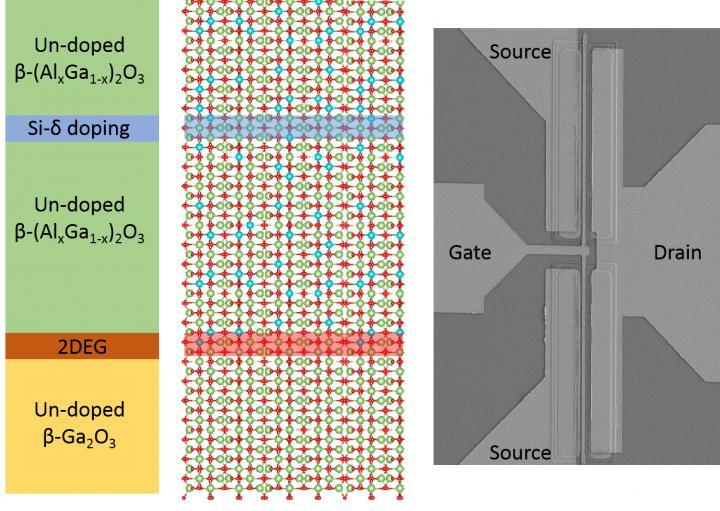
The new material consists of silicon-doped alpha-phase aluminum gallium oxide, chemically represented as α-(AlₓGa₁₋ₓ)₂O₃. The researchers grew the material as thin films on sapphire substrates using suboxide molecular-beam epitaxy, a technique that enables precise control over crystalline film growth. By introducing silicon dopants at sufficiently low growth temperatures, the team created mobile electrons that allow electrical current to flow through a material that would otherwise exhibit highly insulating behavior.
In the ultrawide-bandgap range above 6 eV, the silicon-doped films demonstrated room-temperature electrical conductivity more than 100 million times higher than previously reported results for materials in this category. This achievement addresses one of the central challenges in ultrawide-bandgap semiconductor development: maintaining controllable electrical conductivity as the bandgap increases.
To demonstrate the material's potential for practical electronics, the researchers fabricated a working Schottky diode and a field-effect transistor called the AlphaFET. The preliminary transistor demonstrated current modulation exceeding four orders of magnitude through silicon doping and an applied electric field, confirming that the material can support controllable electronic device operation.
Another important advantage is the use of sapphire as the growth substrate. Unlike some advanced semiconductor materials that face challenges involving manufacturing costs, crystal growth and wafer availability, sapphire is already widely produced at industrial scale. This could provide a more accessible foundation for developing future ultrawide-bandgap electronic devices.
The technology could eventually support high-voltage, high-efficiency power electronics for electric vehicles, aircraft electrical propulsion systems, power grids and AI data centers. Researchers also see potential applications in telecommunications quantum cascade lasers and vacuum-ultraviolet (VUV) photonic devices, expanding the possibilities for next-generation semiconductor and optical technologies.
Despite the breakthrough, further engineering and device development will be necessary before commercial deployment. The study, led by researchers including Darrell Schlom, Huili Grace Xing and Debdeep Jena, establishes silicon-doped aluminum gallium oxide as a promising platform for future high-power electronics and advanced photonic systems.