

Product Description
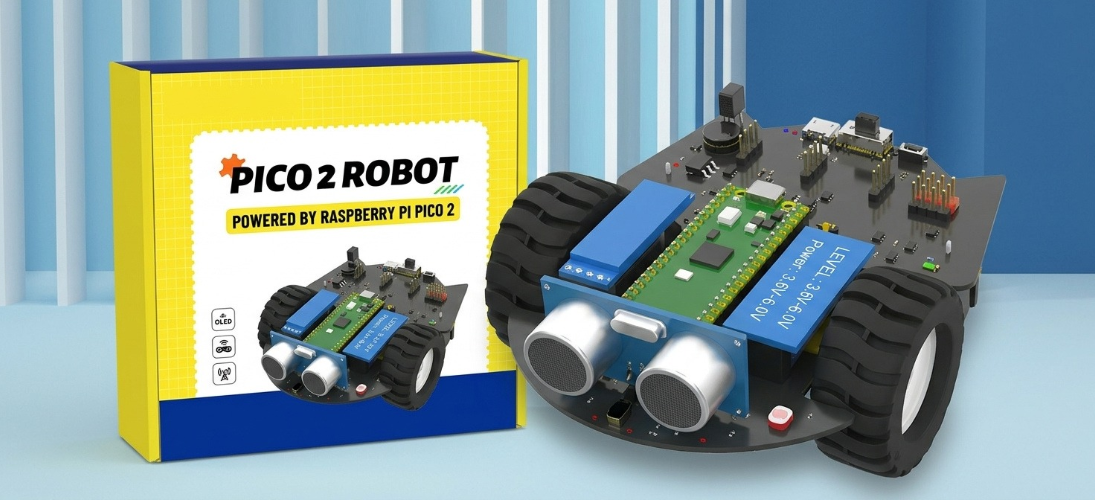
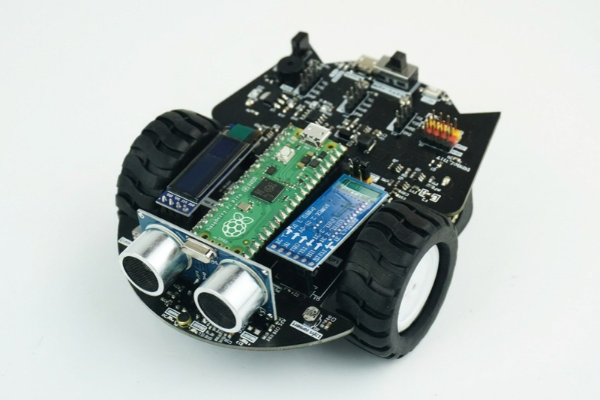
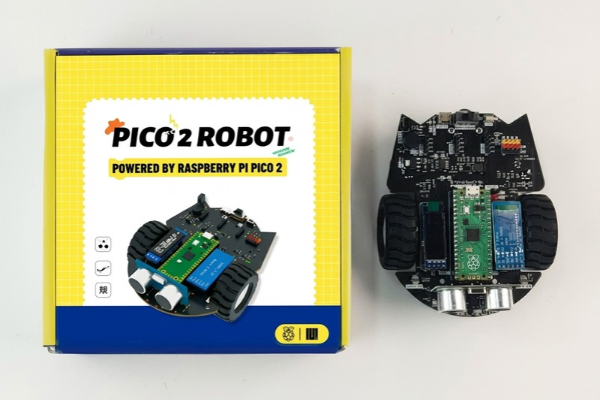
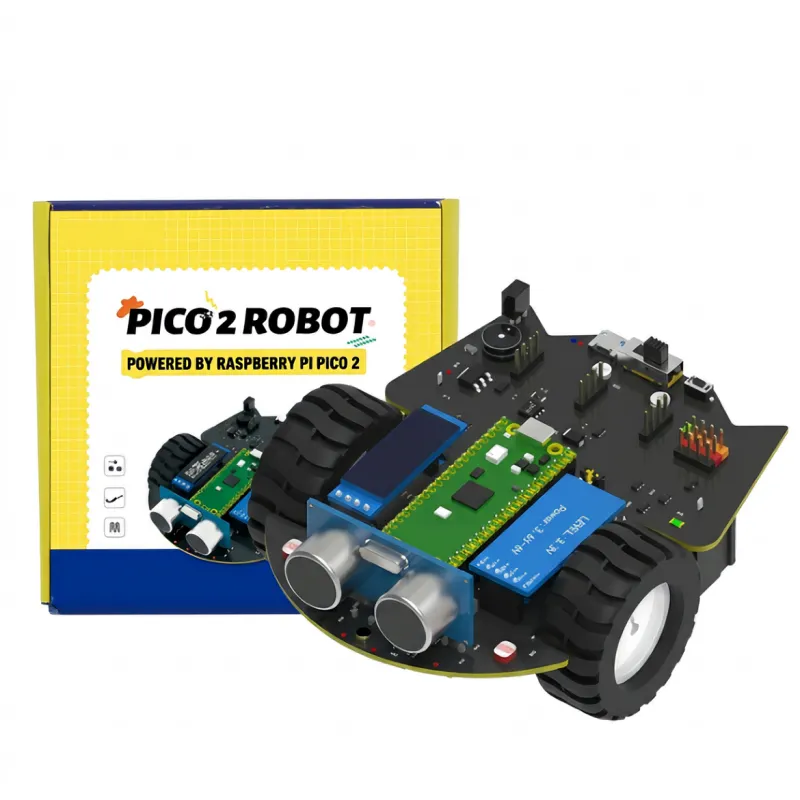
Pico 2 Robot Smart Car
1-on-1 Online Technical Guidance / 30 Teaching Courses
|
|
|
| Raspberry Pi Pico 2 | MicroPython Programming ผ | iOS/Android App Remote Control |


|
|
|
|
|
Supports Infrared Remote Control | Line-Following Mode | Cliff Detection | Ultrasonic Obstacle Avoidance | Object Following |


|
|
|
|
|
| Voice-Controlled Car | Light-Seeking/Following | Colorful RGB Lighting | OLED display | Remote Control via iOS/Android App |


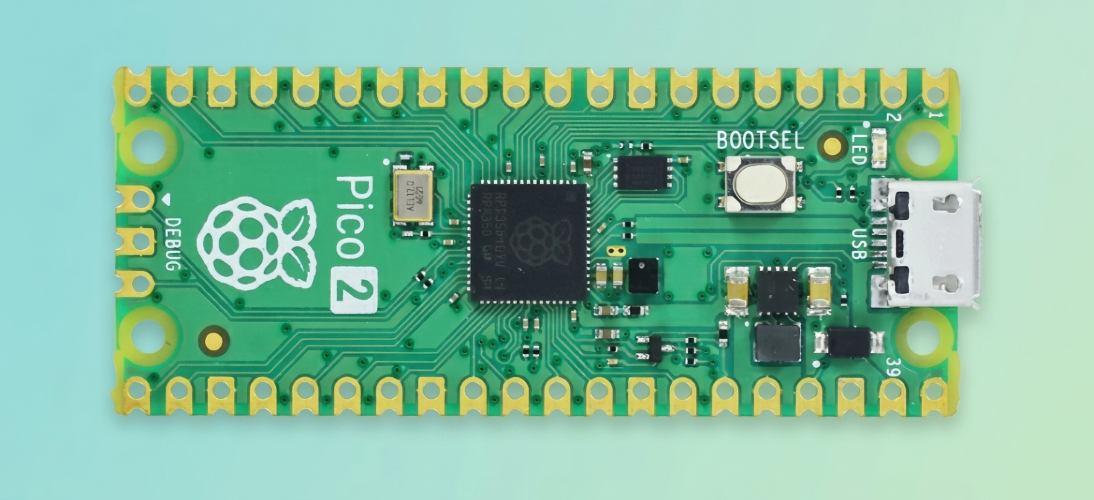
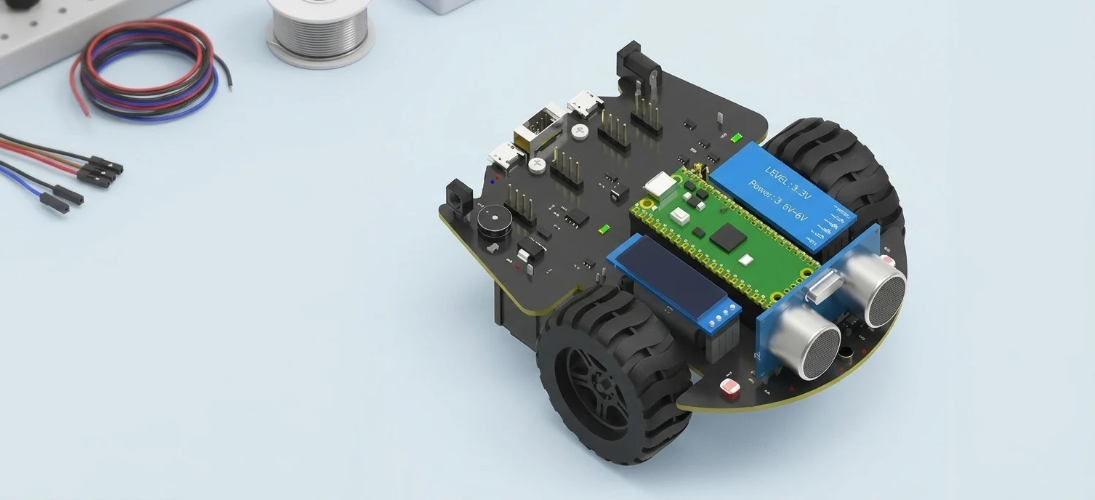
Based on the Raspberry Pi Pico 2 Board
The Raspberry Pi Pico 2 is a low-cost, high-performance microcontroller development board with flexible digital interfaces. In terms of hardware, it adopts the RP2350 microcontroller chip independently developed by Raspberry Pi, featuring a unique dual-core and dual-architecture design, a running frequency of up to 150 MHz, 520 KB of built-in SRAM, 4 MB of memory, and 4 MB of onboard flash memory, along with up to 26 multi-function GPIO pins. In terms of software, developers can choose the C/C++ SDK provided by Raspberry Pi or use MicroPython for development. Coupled with comprehensive development materials and tutorials, it allows users to easily get started with development and quickly embed it into products.
Configuration Instructions
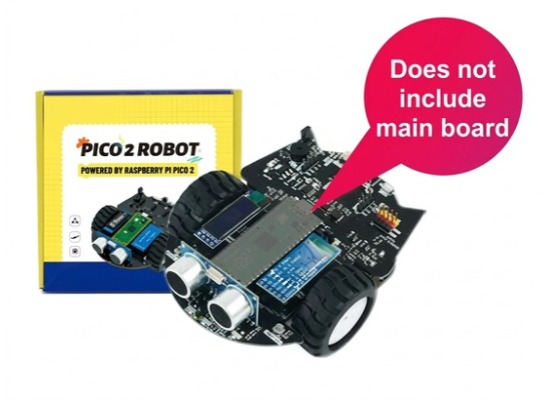
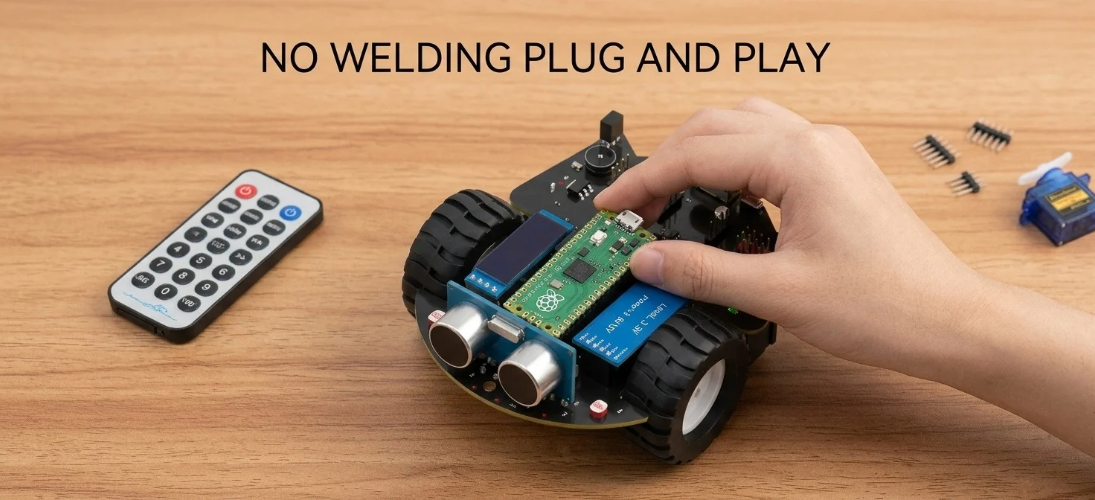
Does not include the Pico board
(Suitable for those who already own a Raspberry Pi Pico 2/Pico)
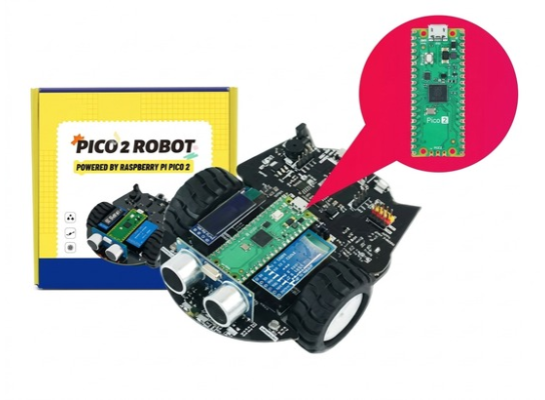
Includes Pico2 main board
(Complete set—ready to play right out of the box)
This product is compatible with both Pico 2 and Pico.
Configurations including the motherboard in our store default to using the Pico 2 board.
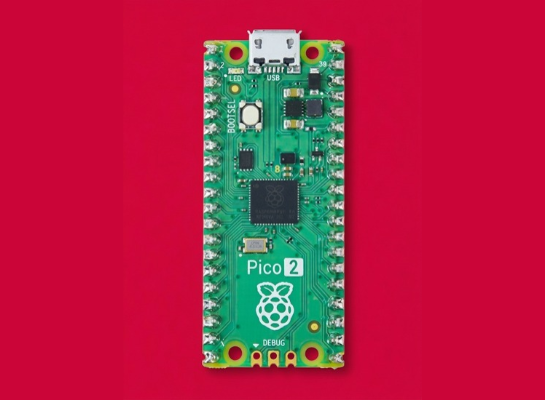
Raspberry Pi Pico 2
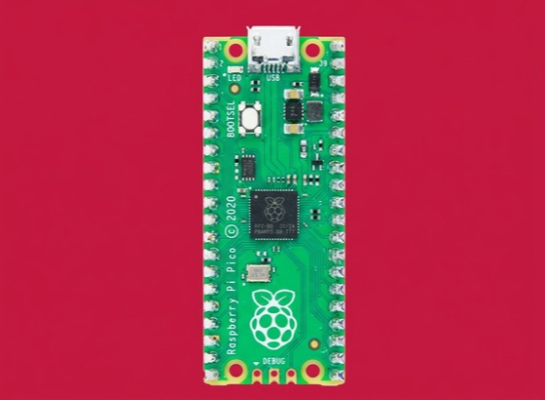
Raspberry Pi Pico
Product parameters
Pico 2 vs Pico Parameter Comparison | ||
Appearance |
Execution speed increased twofold |
|
Model / Parameter | Pico 2 | Pico |
Chip Model | RP2350A | RP2040 |
Core Architecture | Dual-core Cortex-M33 or RISC-V Hazard3 processors | Dual-core ARM Cortex M0+ |
Clock Speed | 150MHz | 133MHz |
On-chip SRAM | 520KB | 264KB |
On-board OSPI Flash | 4MB | 2MB |
Interfaces | 26 GPIO pins (3 can be used for ADC) | 26 GPIO pins (3 can be used for ADC) |
PIO | 3x Programmable IO(PIO) blocks, 12 state machines total | 2x Programmable IO(PIO) blocks, 8 state machines total |
Peripherals | 2 x UART 16 x PWM channels | |
Supply Voltage | 5V | |
Pin Count | 40 Pin | |
Programming Languages | MicroPython, C, C++ | |
Programmed with MicroPython
MicroPython is a lean and efficient implementation of the Python 3 programming language. The Raspberry Pi Pico is a compact microcontroller development board combined with a streamlined Python operating system, which can be used to control various electronic projects. MicroPython allows you to quickly develop and bring your creative ideas to life, and supports easy code transfer to the Pico robot car.
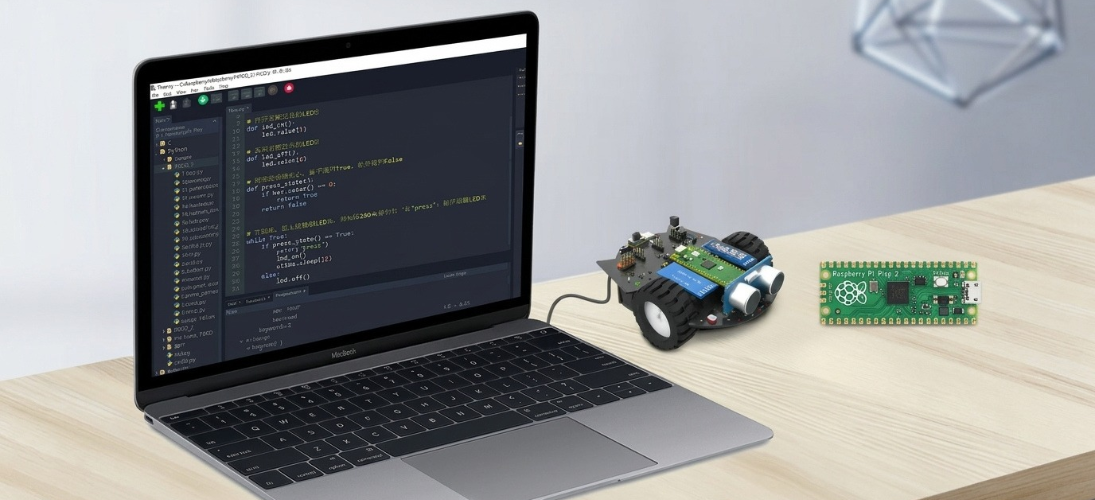
FUNCTIONLIST
1. Update firmware 2. Set up the development environment 3. Download routines (example codes) and enable auto-run on boot 4. Import library files 5. Control the onboard LED flashing 6. Onboard temperature sensor | 1. Servo control 2. Car forward movement 3. Car fancy/stunt movements 4. Passive buzzer basics 5. Car singing and dancing 6. Light sensor basics 7. Light-seeking follow 8. Sound sensor basics 9. Voice-controlled car 10. OLED display | 1. Battery level display 2. Line tracking sensor basics 3. Line tracking car 4. Cliff detection 5. Ultrasonic sensor basics 6. Ultrasonic obstacle avoidance 7. Ultrasonic following 8. Breathing light 9. Running/chasing lights (Marquee light) | 1. iOS/Android APP Remote Control 2. Infrared (IR) Remote Control (Standard) |
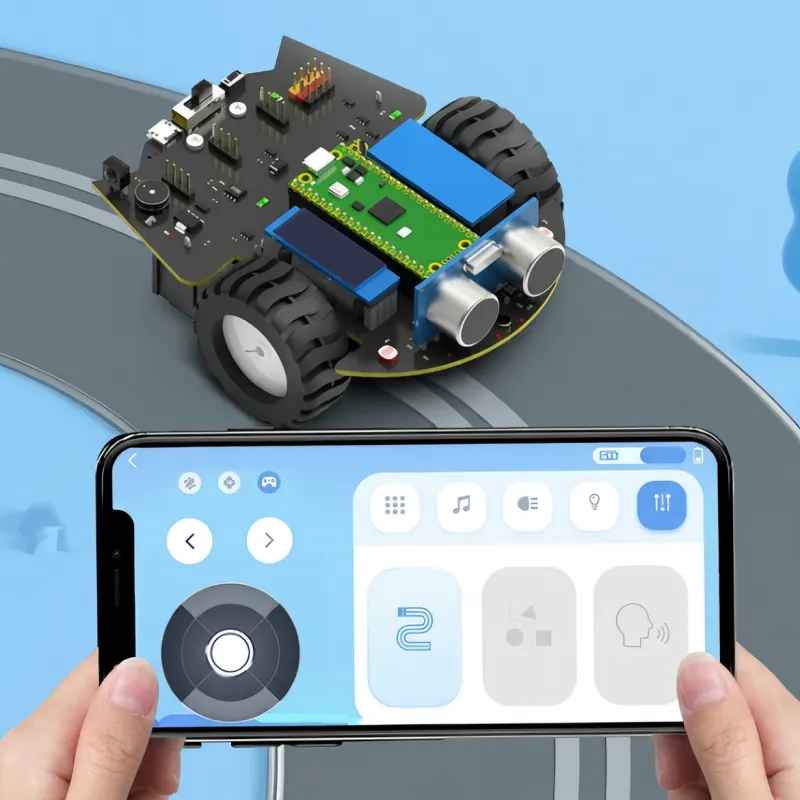
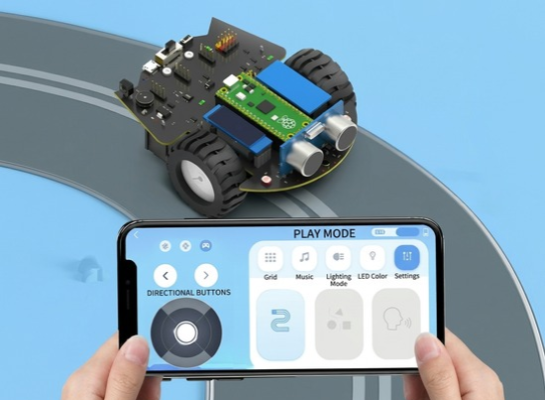
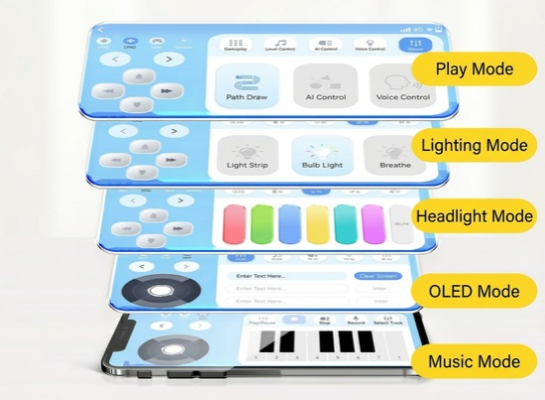
Supports APP Bluetooth Remote Control
The APP can control Pico Robot's motor movement status, OLED display, music playback, lighting effects, line tracking, obstacle avoidance, sound control mode, and other functions.
(iOS/Android)
|
|
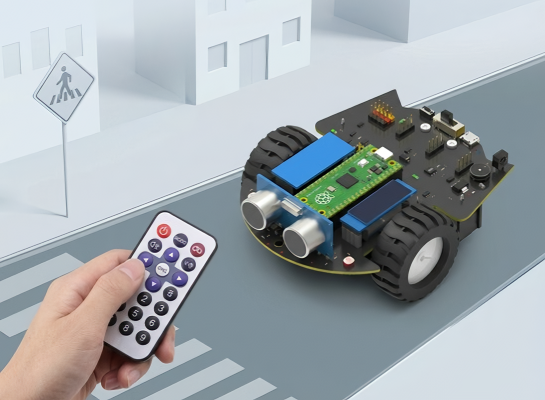
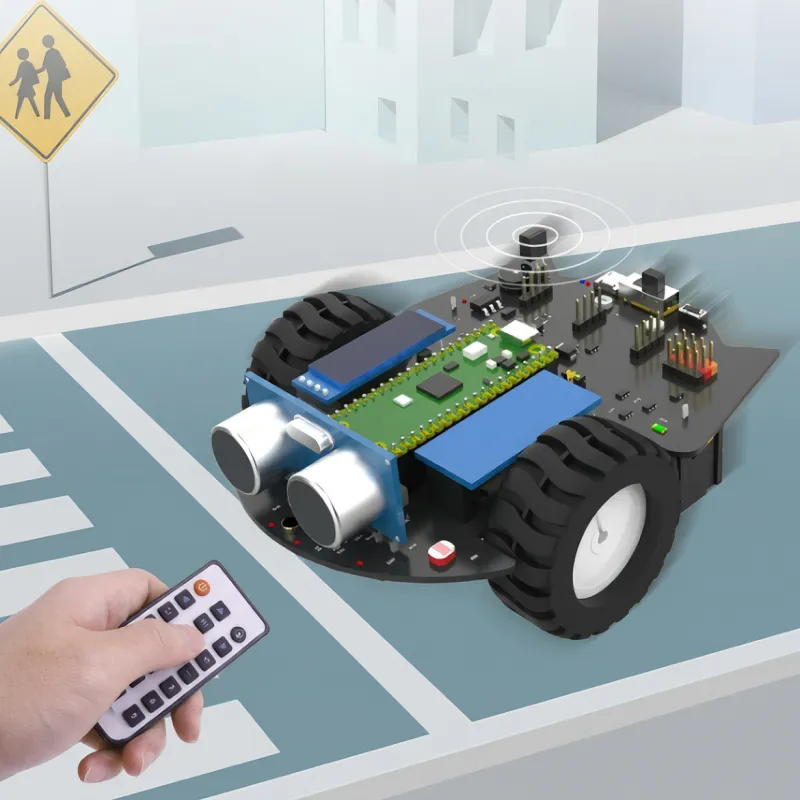
Infrared Remote Control
The PicoRobot can receive signals emitted by an infrared remote control. By recognizing the code value of each remote button, it enables the robot car to perform different actions.
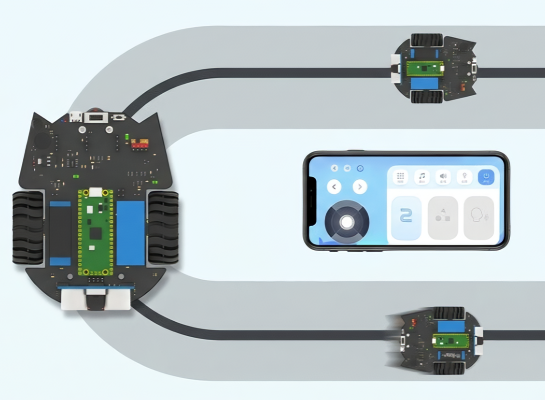
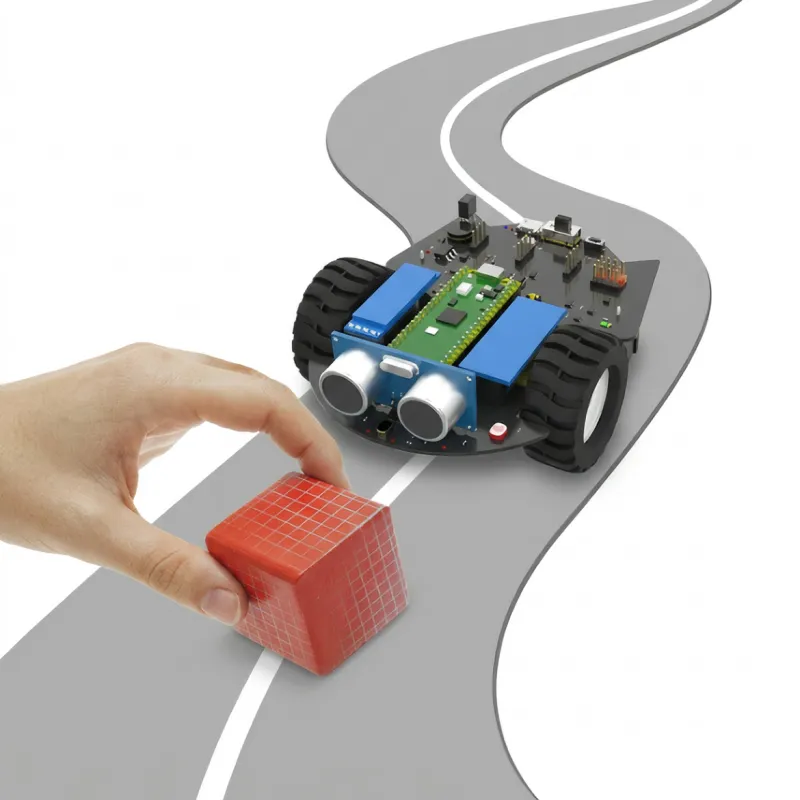
Line-Tracking Mode
By using line-tracking sensors to detect the black-and-white digital signals between the ground and the black line, the robot adjusts its movement direction to keep following the black-line path.
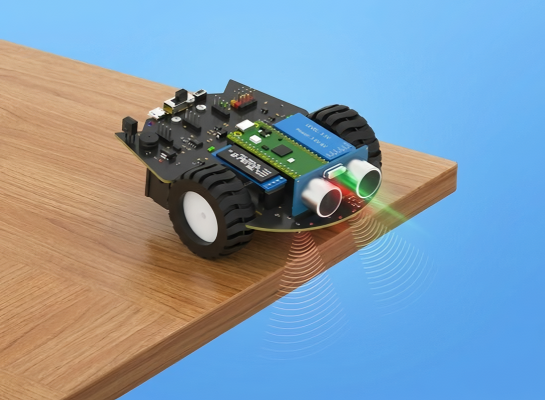
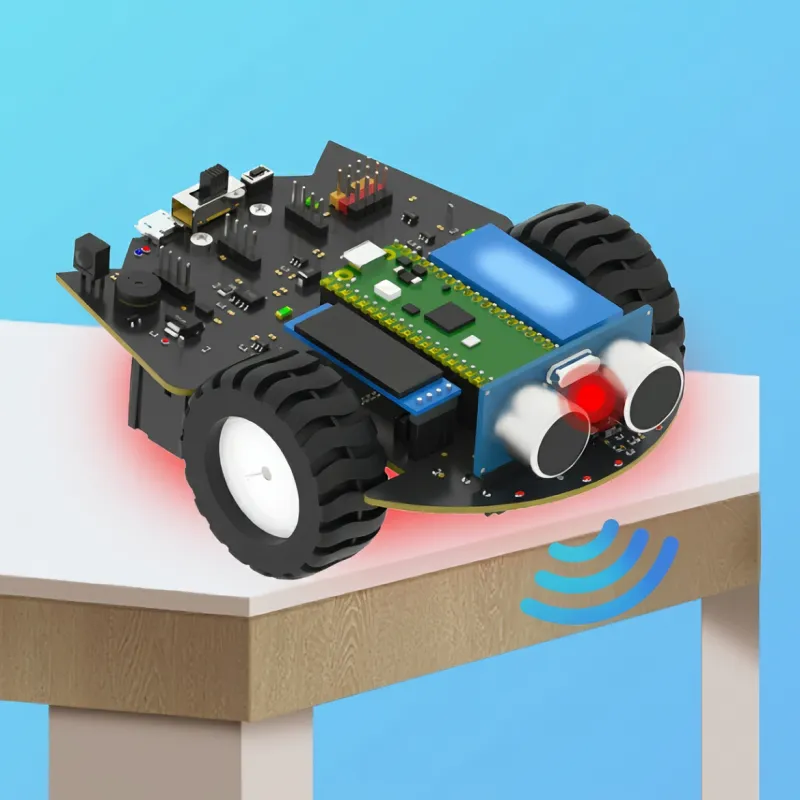
Cliff Detection
By monitoring the status of the infrared sensors in real-time to detect the ground, when the robot car approaches the edge of a table and the sensors fail to receive a reflected signal, the car will back up to move away from the 'cliff.'
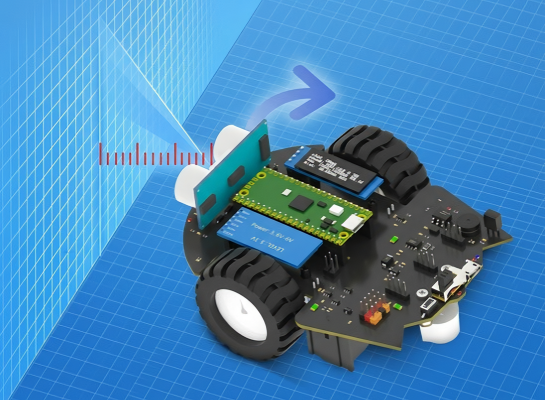
By emitting ultrasonic signals through an ultrasonic sensor and calculating the signal return time, the robot car determines the distance of obstacles ahead to achieve distance measurement and obstacle avoidance.
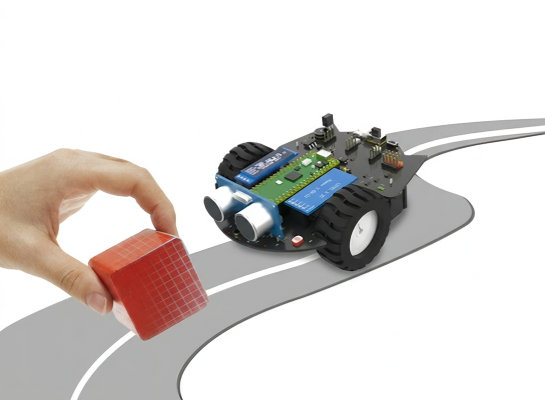
Object Following
By using the principle of real-time ranging via ultrasonic sensors, the robot car can maintain a fixed distance from an obstacle ahead, achieving an object-following effect.
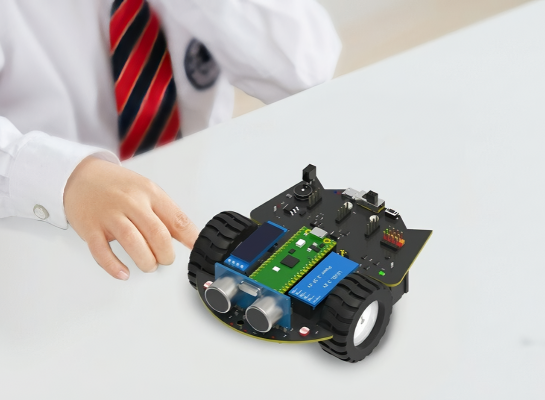
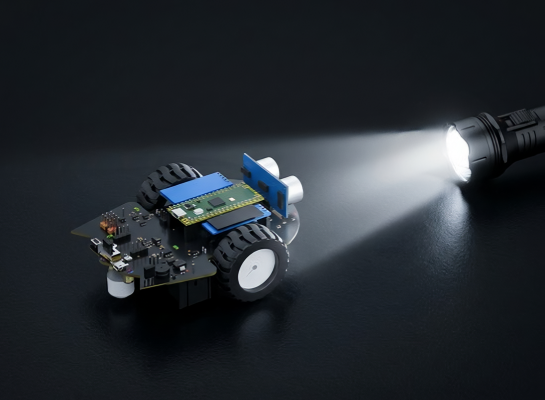
Infrared Remote Control
The PicoRobot can receive signals emitted by an infrared remote control. By recognizing the code value of each remote button, it enables the robot car to perform different actions.
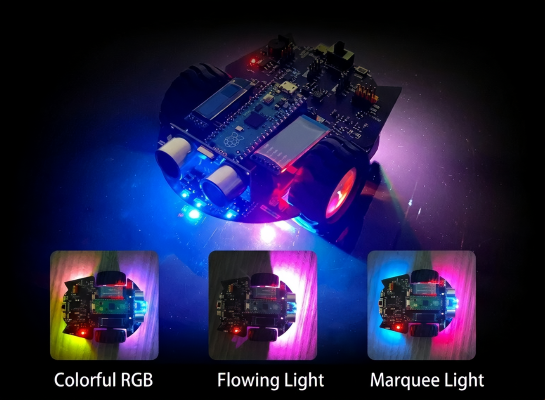
Infrared Remote Control
The PicoRobot can receive signals emitted by an infrared remote control. By recognizing the code value of each remote button, it enables the robot car to perform different actions.
PICO TROLLEY COURSE SYLLABUS | |
1. Pico Robot Introduction | 4. Advanced Sensor Courses |
1.1 Introduction to Pico Robot | 4.1 Photosensitive Sensor |
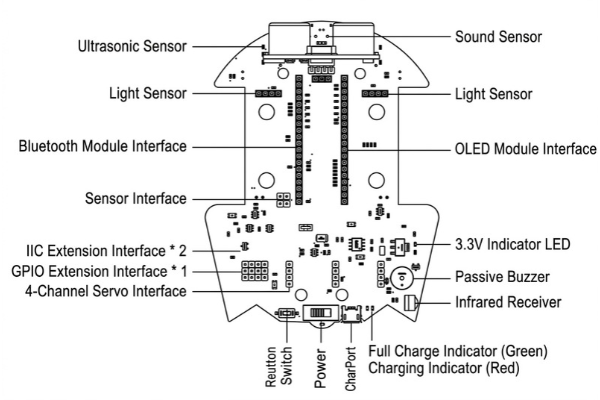
1.2 Interface Description | 4.2 Sound Sensor |
1.3 Assembly Steps | 4.3 Line-Tracking Sensor |
1.4 Battery & Precautions | 4.4 Ultrasonic Sensor |
1.5.1 Bluetooth Remote Control | 4.5 Infrared Remote Control Display |
1.5.2 Infrared Remote Control | |
2. Development Environment Setup | 5. Robot Courses |
2.1 Updating Firmware | 5.1 Car Forward Movement |
2.2 Setting Up Development Environment | 5.2 Car Fancy Actions |
2.3 Downloading Code & Auto-run on Boot | 5.3 Car Singing & Dancing |
2.4 Importing Library Files | 5.4 Line-Tracking Car |
3. Basic Courses | 5.5 Cliff Detection |
3.1 Controlling Onboard LED Blinking | 5.6 Ultrasonic Obstacle Avoidance |
3.2 Onboard Temperature Sensor | 5.7 Ultrasonic Following |
3.3 Passive Buzzer | 5.8 Light-Seeking Following |
3.4 Breathing Light | 5.9 Voice-Controlled Car |
3.5 Marquee / Running Light | 5.10 Infrared Control |
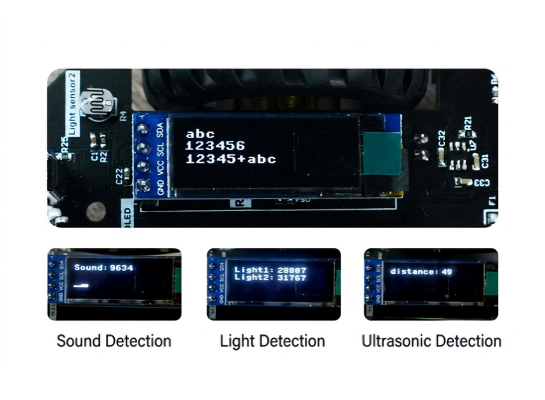
3.6 OLED Display | 5.11 Bluetooth Control |
3.7 Battery Level Display | |
3.8 Servo Control | |
|
|
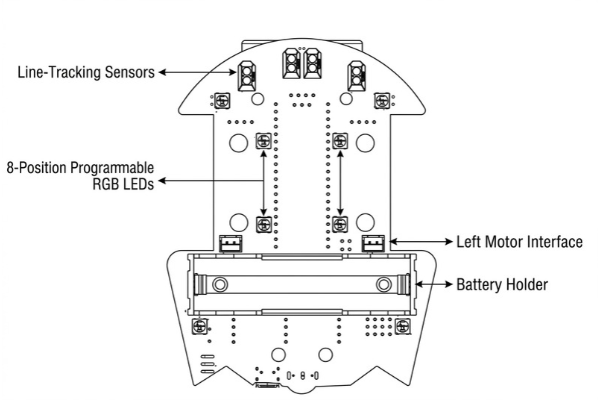
PICO ROBOT PRODUCT PARAMETERS | |
Main Control Board | Raspberry Pi Pico 2 |
Battery Life | 2.5 Hours |
Microcontroller | RP2350 |
Power Supply | Single 18650 2200mAh Battery |
Charging Interface | Micro-USB |
Communication Mode | Bluetooth 5.0 |
Remote Control Mode | Mobile APP / Infrared Remote Control |
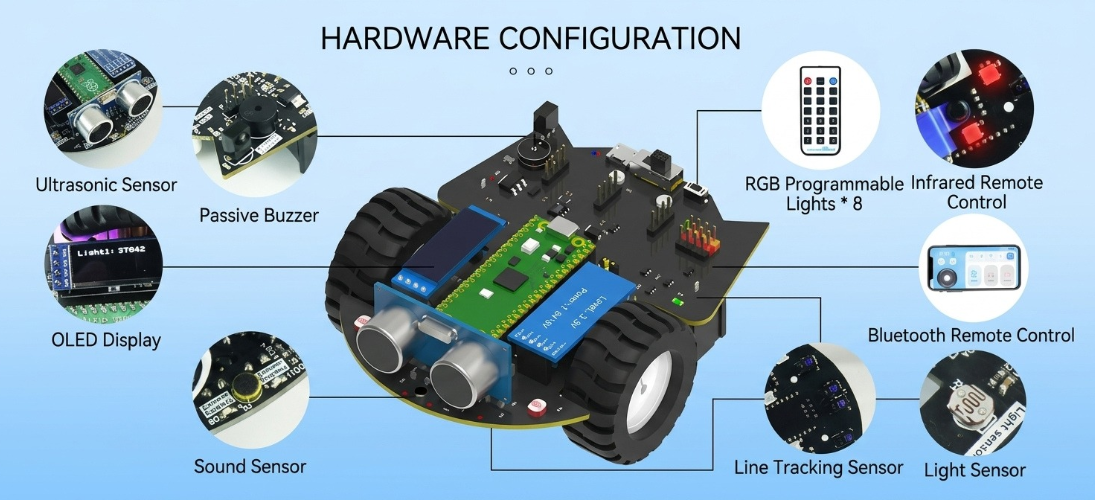
Input Devices | Photosensitive Resistor, 4-Channel Line-Tracking, Sound Sensor, Ultrasonic, Bluetooth, IR Receiver |
Output Devices | OLED Display, Passive Buzzer, N20 Motors, Servo Interfaces, Programmable RGB LEDs |
Safety Protection | Overcurrent Protection, Overcharge Protection, Motor Stall Protection |
Motor Scheme | N20 Motors * 2 |
Assembled Size | 120mm * 96mm * 56mm |
Assembled Weight | 182g |
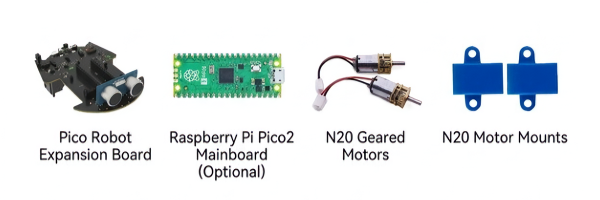
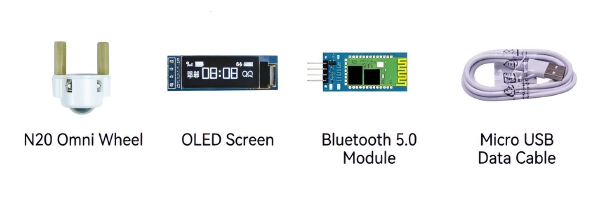
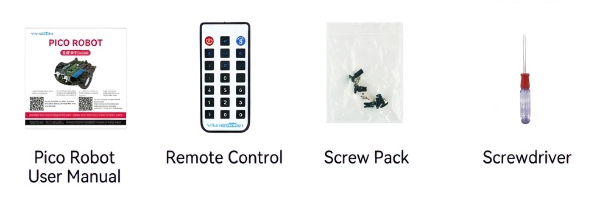
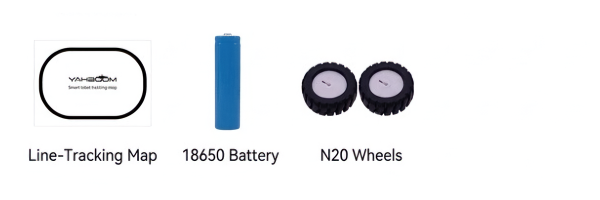
Packing List
|
|
|
|
|
|