


The global industrial robot installation market has reached a record high of $16.7 billion. Future demand will be driven by a range of technological innovations, market forces, and emerging business areas. On January 8, 2026, the International Federation of Robotics (IFR) released its five core trends for the robotics industry in 2026.
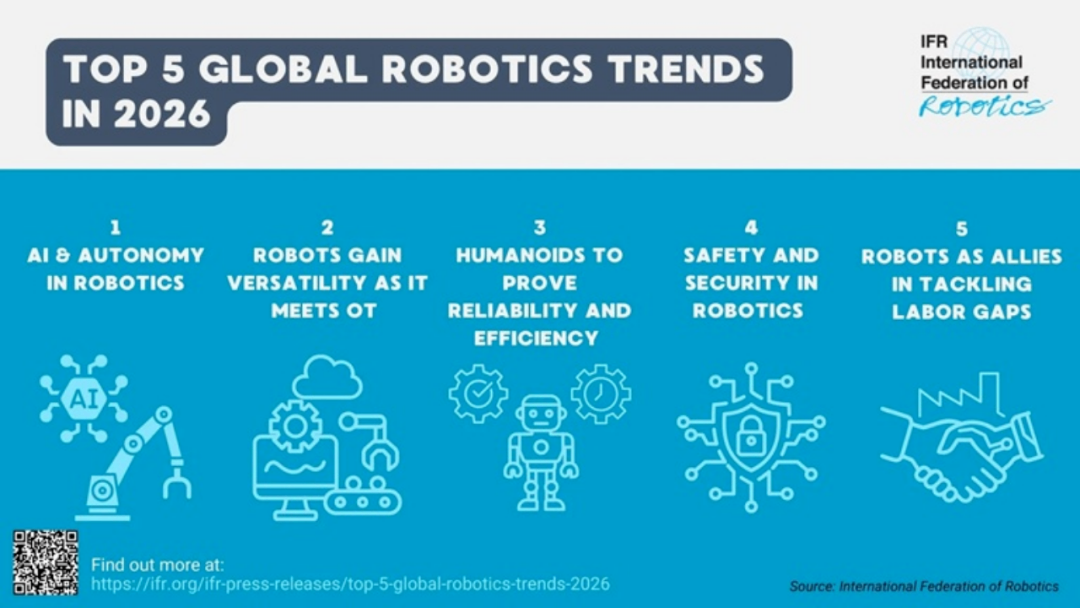
Trend 1: Artificial Intelligence and Robot Autonomy
Robots capable of working independently using artificial intelligence are becoming increasingly common. In this context, the main advantage of AI is its significantly enhanced autonomy.
This trend is driven by several types of AI technologies:
Analytical AI: Capable of processing massive amounts of data, recognizing patterns, and providing actionable insights. For example, in smart factories, robots can predict equipment failures in advance; in logistics scenarios, they can autonomously optimize path planning and resource allocation.
Generative AI: Marks the shift from rule-based automation to intelligent, self-evolving systems. Generative AI can create new outputs, enabling robots to autonomously learn new tasks in simulation environments and generate training data. Simultaneously, it also opens up entirely new ways of human-computer interaction—users can directly control robots through natural language or visual commands.
Agentic AI: This is a key direction for further enhancing robot autonomy. This technology integrates the structured decision-making capabilities of analytical AI with the adaptability of generative AI, aiming to enable modern robots to operate independently in complex real-world environments.
Trend 2: IT and OT Convergence, Giving Robots Greater Versatility
The market demand for multi-functional, general-purpose robots is accelerating, directly reflecting the major trend of convergence between information technology (IT) and operational technology (OT).
IT excels in data processing and advanced analytics, while OT focuses on the real-time control of physical equipment. Their convergence, through real-time data exchange, automation, and deep analysis, greatly enhances the versatility and adaptability of robots. This integration is a core foundation for digital enterprises and Industry 4.0.
IT/OT convergence breaks down the "information silos" between traditional systems, enabling seamless data flow between the digital and physical worlds, thereby significantly expanding the application potential of robots across scenarios and industries.
Trend 3: Humanoid Robots Need to Verify Reliability and Efficiency
The field of humanoid robots is expanding rapidly. Industrial humanoid robots are considered a highly promising technology in scenarios requiring high flexibility (especially in work environments designed for humans). The automotive industry pioneered their applications, and now global deployments in warehousing and manufacturing are gradually unfolding.
Currently, companies and research institutions are no longer limited to prototype development but are beginning to deploy humanoid robots in real-world environments. Reliability and efficiency are becoming critical: to compete with traditional automation solutions, humanoid robots must meet stringent industrial standards—including cycle time, energy consumption levels, and maintenance costs.
Furthermore, industry standards have set clear requirements for the safety levels, durability, and continuous performance on production lines of humanoid robots. To truly fill the labor shortage, humanoid robots need to achieve near-human dexterity and productivity, which are core indicators for measuring their practical value.
Trend 4: Robot Safety and Cybersecurity Are Increasingly Important
As robots increasingly collaborate with humans in factories and service scenarios, ensuring their safe operation is not only an important matter but also the cornerstone of the entire robotics industry's development.
AI-driven autonomy has fundamentally altered the security paradigm, making testing, verification, and human oversight more complex—but also more necessary. This is particularly evident in the application of humanoid robots. Robotic systems must be designed and certified according to ISO safety standards, and a clear framework for assigning responsibility must be established.
In the context of the convergence of AI and IT/OT, security and safety issues present a broader range of challenges, urgently requiring robust governance mechanisms and clear legal accountability. As robotic systems increasingly connect to the cloud and rely on AI, industrial production is facing growing cybersecurity threats. Experts point out a significant increase in hacking attempts targeting robot controllers and cloud platforms, potentially leading to unauthorized access or even system manipulation.
Furthermore, the video, audio, and sensor data collected by robots during operation involves a large amount of sensitive information, raising privacy concerns. Deep learning models are often considered "black boxes," with their decision-making processes difficult to explain, and even developers cannot be fully traced. This legal and ethical ambiguity has prompted calls for a clear governance framework for AI deployment.
Trend 5: Robots Become "Allies" in Addressing Labor Shortages
Employers worldwide are facing a widespread shortage of skilled workers. Job vacancies are forcing existing employees to take on extra shifts, leading to a sustained increase in stress and fatigue across industries.
One key strategy to address this challenge is the introduction of robotics and automation technologies. Engaging existing employees in this transformation is crucial. Whether in industrial manufacturing or diverse service scenarios, widespread acceptance of robotics deployment can only be achieved through close collaboration with employees.
Robots not only alleviate labor shortages and replace repetitive tasks, but they also open up new career paths, thus increasingly being seen as "collaborative partners" rather than "replacements" in the workplace. Simultaneously, intelligent work environments are making companies more attractive to younger generations.
Currently, governments and businesses worldwide are vigorously promoting skills training and retraining programs to help workers adapt to changing skills demands and remain competitive in the automation-driven new economy.

