


Summary: Researchers have shown that small changes in robot body design can dramatically alter swarm behavior, enabling collective phototaxis and self-organized clustering without complex computation.
Researchers from Sorbonne University, CNRS, ESPCI Paris, and collaborating institutions have demonstrated that a robot’s physical design can be as important as its software in determining how a swarm completes tasks. Published in Nature Communications, the study highlights the growing role of morphological computing, where a robot’s shape and structure help perform computation through physical interactions.
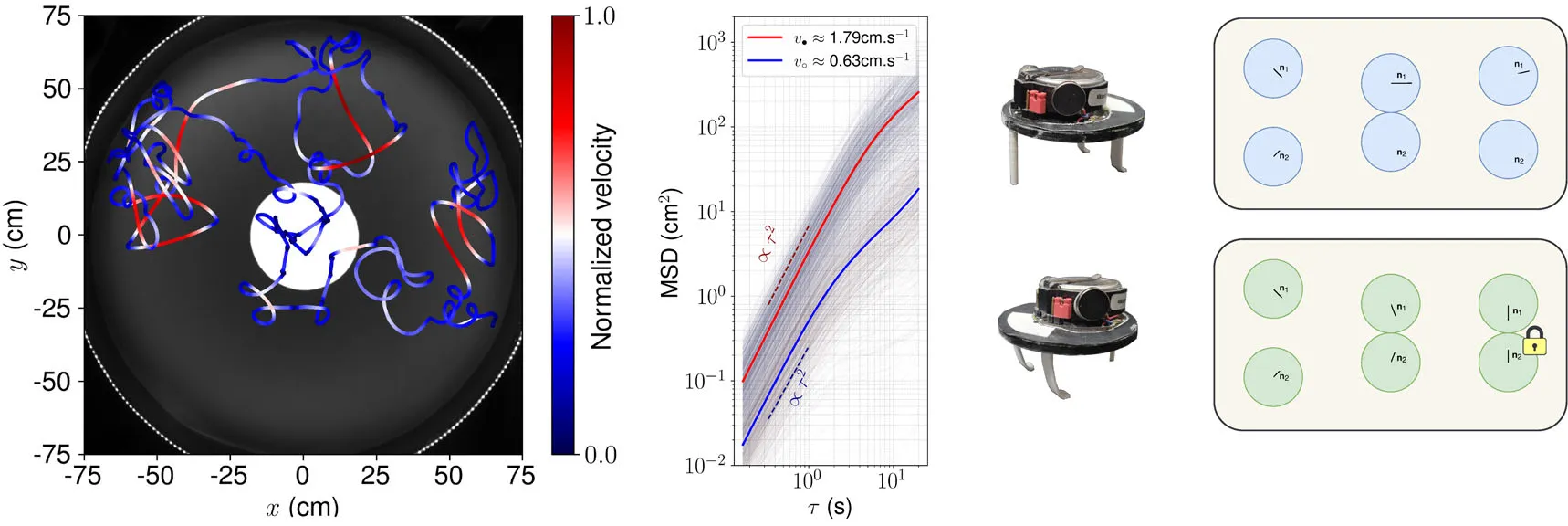
Aligner and Fronter Exoskeleton Designs, Self-Alignment Mechanism, and Phototaxis Experiment Setup
The team modified 64 Kilobot swarm robots with custom 3D-printed exoskeletons that changed how the robots responded to forces during collisions. Two designs were tested: Aligners, which turn toward external forces, and Fronters, which turn away from them.
The robots were assigned a phototaxis task, requiring them to gather inside a small illuminated area. Unlike previous experiments, the robots were not allowed to stop completely; they could only slow down when entering the light zone. This constraint forced the swarm to rely on collective behavior rather than individual success.
Results showed a striking difference. Aligner robots failed to aggregate and spread across the arena, while Fronters spontaneously formed dense clusters inside the target area. The effect emerged from collision-driven interactions that reduced robot mobility, triggering a phenomenon known as motility-induced phase separation (MIPS)—a concept widely studied in active matter physics.
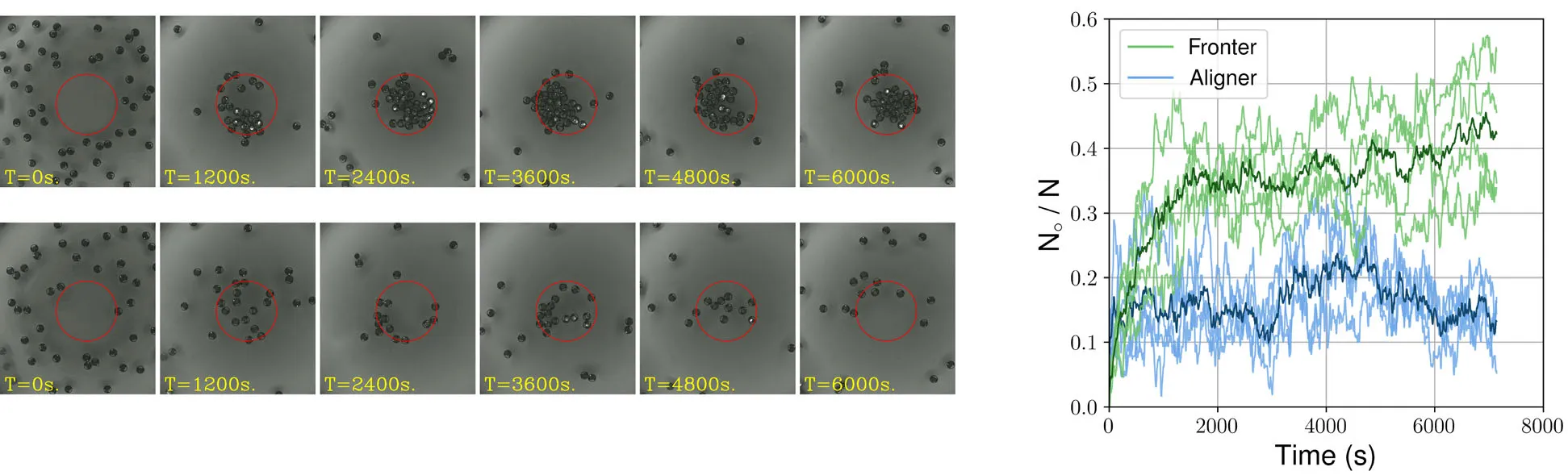
Time-Series Snapshots Comparing Fronter and Aligner Swarm Behavior
Computer simulations confirmed that swarm performance depends on a finely tuned level of self-alignment strength. Too little alignment prevented clustering, while excessive alignment led to flocking or stable micro-clusters that reduced task performance. Researchers identified a narrow “sweet spot” where collective aggregation was most effective.
The findings suggest that future swarm robotics, collective intelligence, and multi-robot systems may be designed not only through algorithms but also through carefully engineered physical structures, opening new possibilities for adaptive robotic swarms and embodied AI.

