


Summary:Researchers have developed a 140-milligram insect-scale robot that can fly, crawl, glide on water, and perform controlled underwater immersion by reusing a single shape-shifting structure for multiple functions.
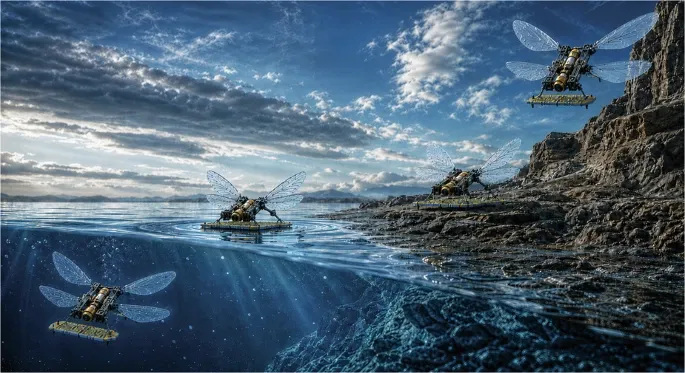
A team of researchers has unveiled Tri-RoboInsect, a 140-milligram insect-scale robot capable of aerial takeoff, terrestrial crawling, water-surface gliding, and controlled underwater immersion. Published in Microsystems & Nanoengineering, the study introduces a new concept called functional recursion, enabling a single robotic structure to perform multiple locomotion tasks without adding extra actuators.
Unlike conventional multimodal robots that require dedicated mechanisms for each environment, Tri-RoboInsect relies on a lightweight H-shaped morphing frame powered by shape-memory alloy (SMA) artificial muscles. The same structure continuously changes its role depending on the environment, reducing weight while expanding mobility.
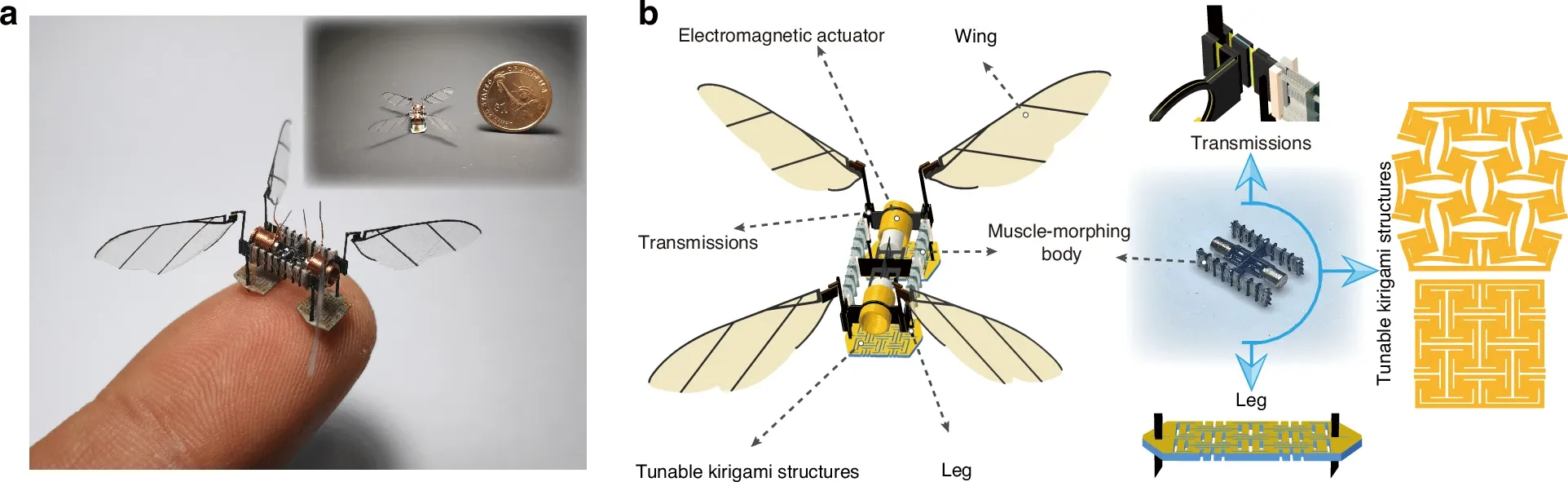
Tri-RoboInsect weighs only 140 mg and measures 35 mm in length. Credit: Microsystems & Nanoengineering.
The robot's morphing frame acts as a steering mechanism during flight, a locomotion engine during crawling, and a deformation actuator for water-surface operations. In flight mode, the frame adjusts wing kinematics to generate open-loop pitch, roll, and yaw control. The four-wing robot achieved a thrust-to-weight ratio of 1.2 and demonstrated takeoff with attitude modulation at a wingbeat frequency of 93 Hz.
On land, the same frame drives reciprocal body deformation that works with anisotropic friction feet to produce crawling motion. The robot reached a top speed of 0.46 body lengths per second on smooth paper surfaces.
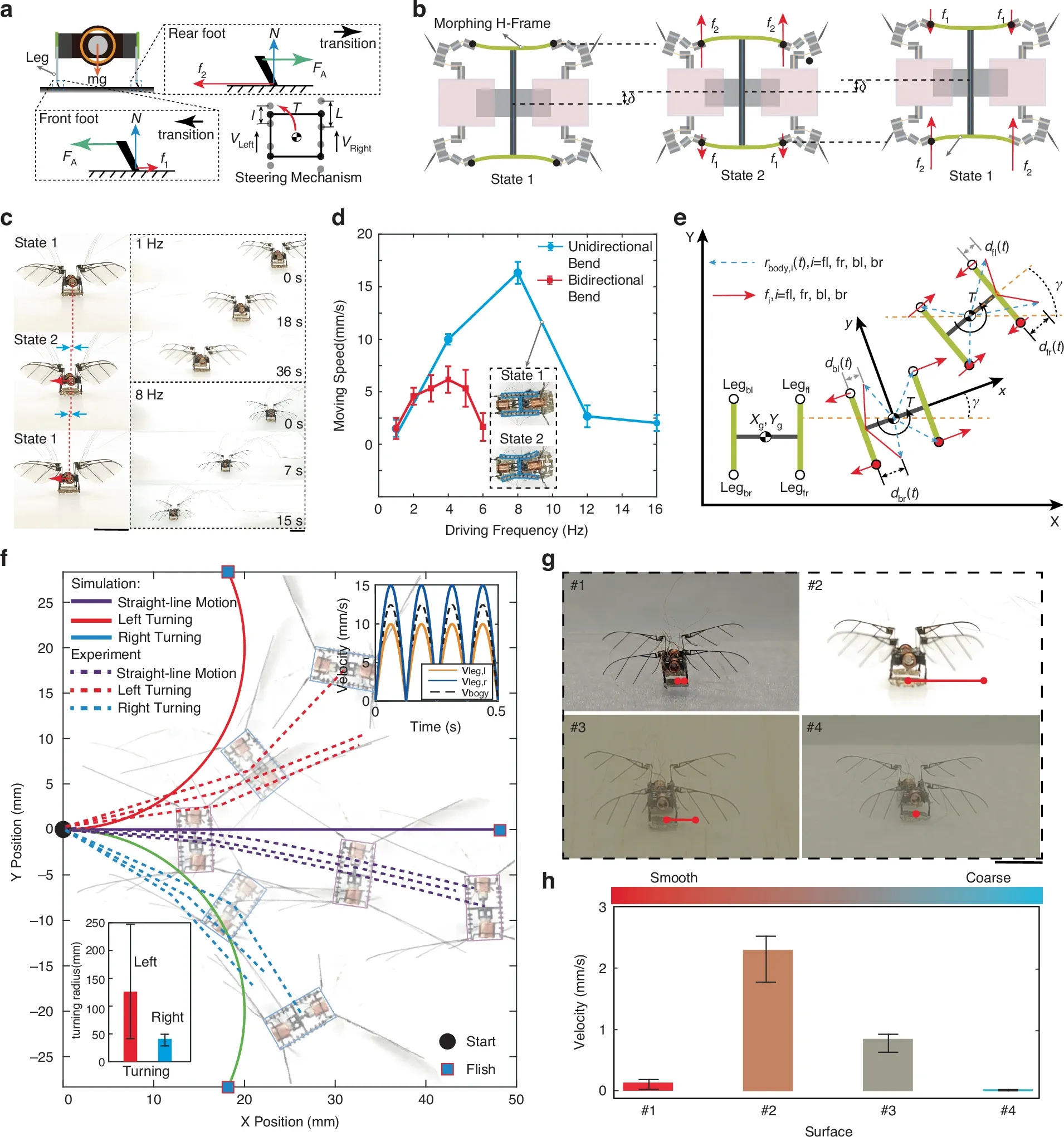
Crawling locomotion is achieved through H-frame deformation and asymmetric friction. Credit: Microsystems & Nanoengineering.
For aquatic operation, researchers integrated kirigami-inspired footpads that exploit surface tension to support the robot on water. Wing flapping generates forward thrust, enabling water-surface gliding at speeds up to 6.3 mm/s.
A key breakthrough is the robot's ability to perform electrowetting-triggered immersion. By adjusting kirigami footpad gaps and applying voltage, the robot can intentionally break the water surface and sink. The system increases load-bearing capacity to 1.7 times its body weight before initiating controlled descent.
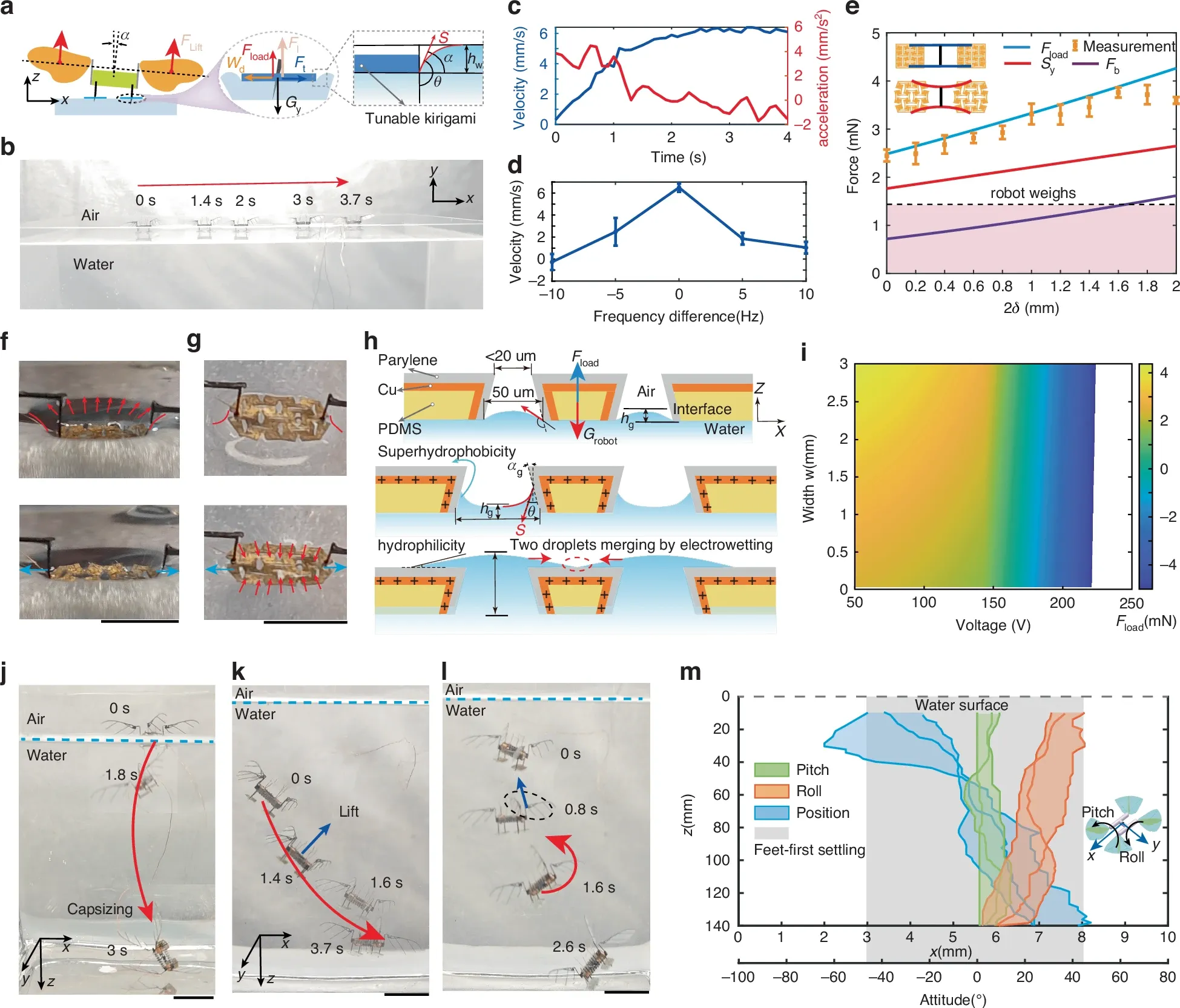
Kirigami footpads enable water-surface support, gliding, and electrowetting-controlled immersion. Credit: Microsystems & Nanoengineering.
Researchers say the design demonstrates how structural intelligence can replace hardware redundancy in miniature robots. Future versions could incorporate onboard power, sensing, and closed-loop control for environmental monitoring, search-and-rescue missions, and inspection of confined or flooded spaces.

