


Summary: Researchers have developed an ultrathin conductive film that combines extreme stretchability, high breathability, and room-temperature bonding, opening new possibilities for wearable electronics and soft robotics.
A team of researchers has introduced a nanoscale anisotropic conductive film (ACF) that could solve one of the biggest challenges in stretchable electronics, wearable health devices, and soft robotics: creating reliable electrical connections without heat, pressure, or bulky adhesives. The study was published in Science Advances on September 18, 2026.
The new ACF is only about 300 nanometers thick and is made from patterned silver nanowires (AgNWs) embedded in a stretchable SEBS elastomer. Unlike conventional conductive films that are several micrometers thick and often require heat or ultraviolet curing, the new design can bond electronics at room temperature using a liquid-volatilization process.
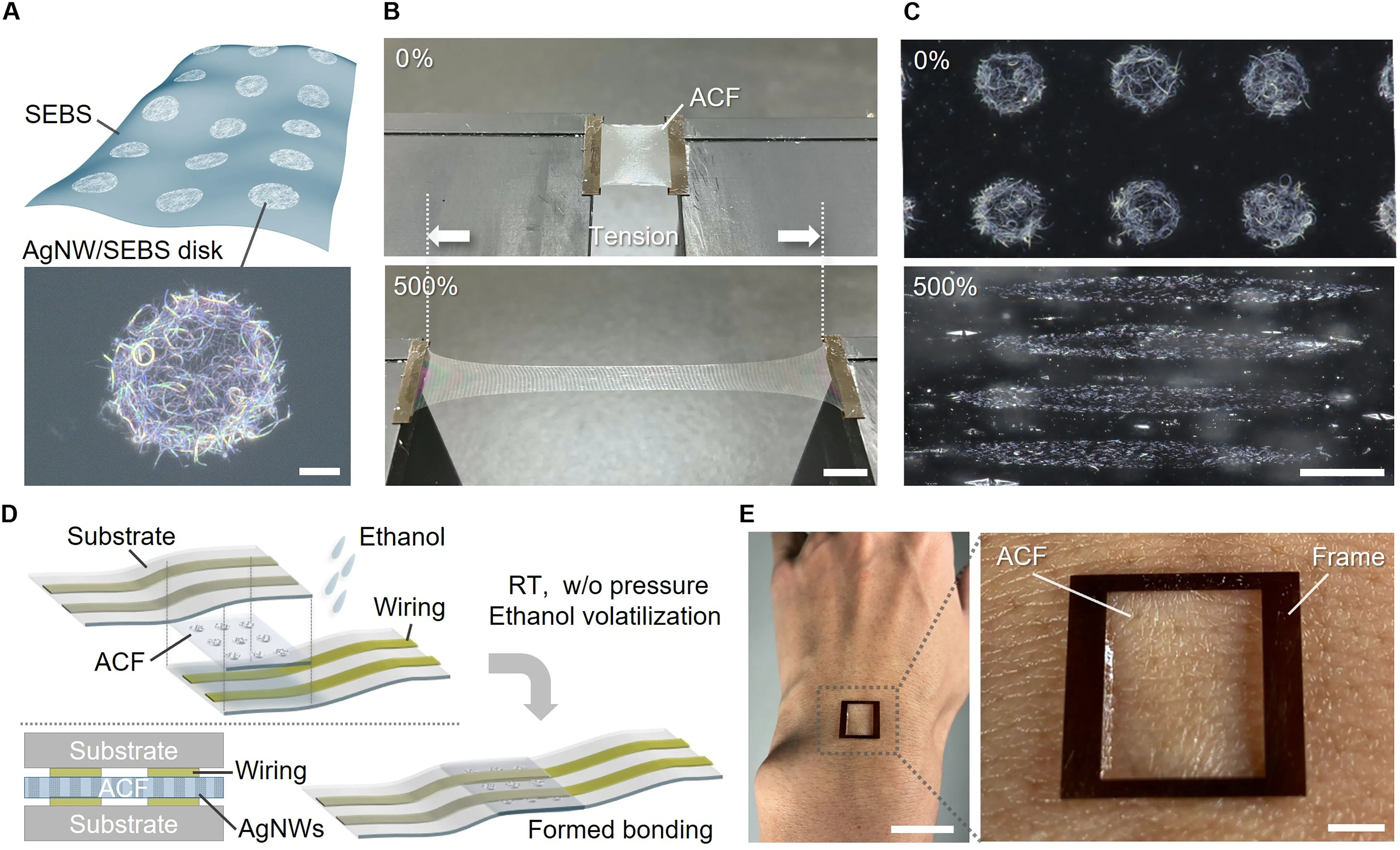
Structure and bonding method of the ultrathin stretchable ACF.
Performance tests showed the film can withstand more than 500% mechanical and electrical strain while maintaining stable conductivity. It also delivers a water vapor transmission rate (WVTR) of approximately 1,200 g/m²/day, significantly higher than many medical skin-adhesion films, making it suitable for long-term skin-contact applications.
The researchers demonstrated direct bonding on human skin and uneven surfaces without damaging delicate electronics. The material maintained conductivity after 1,000 stretching cycles and supported stretchable circuits with integrated LEDs operating reliably under 500% strain.
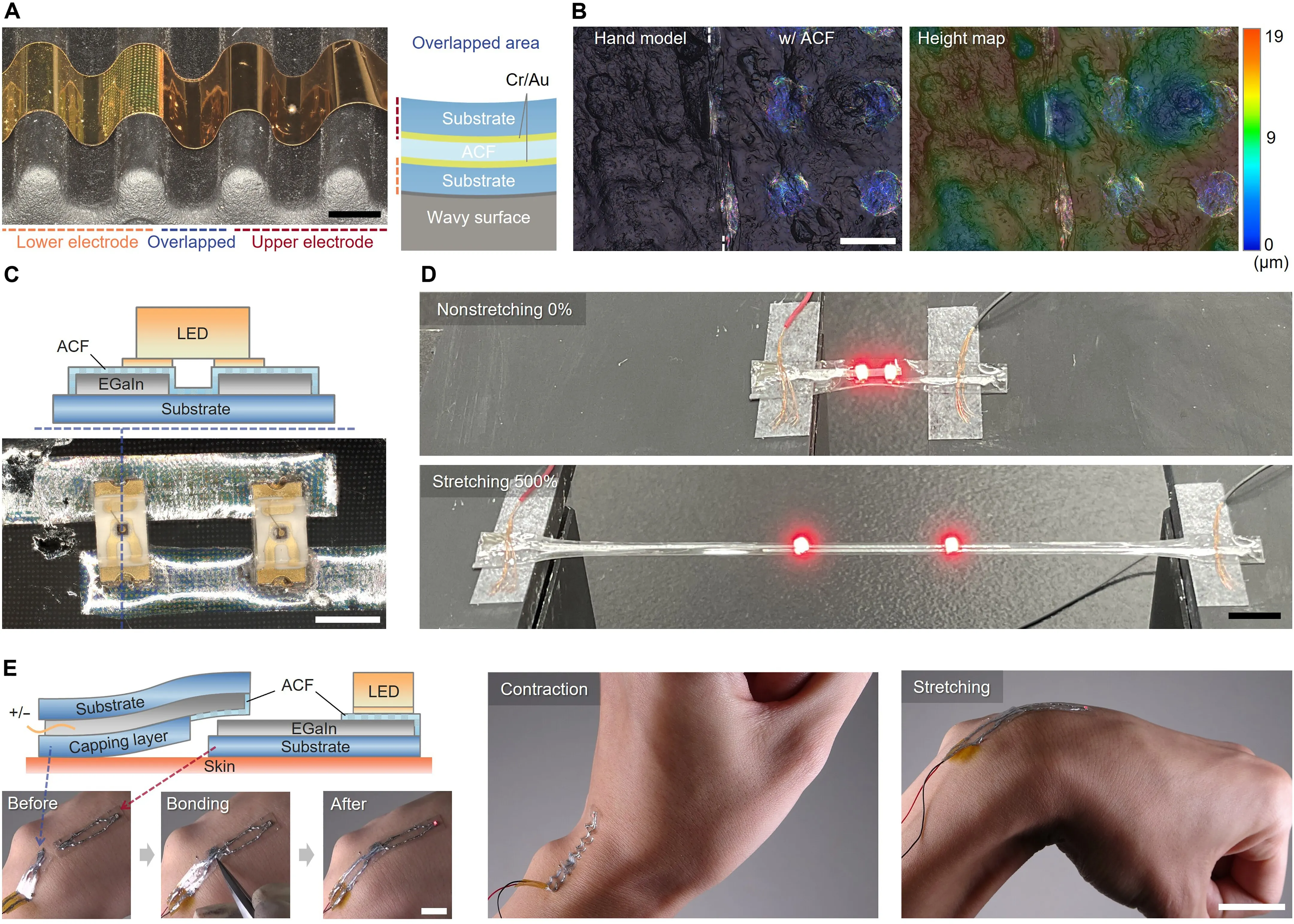
Demonstrations using the ultrathin stretchable ACF.
The technology could enable next-generation electronic skin, health-monitoring wearables, biomedical sensors, and soft robotic systems that require lightweight, breathable, and highly flexible electronic interconnections. Researchers believe the platform may also support future high-density wearable devices and advanced human-machine interfaces.

