


Summary: ETH Zurich researchers have developed a self-walking robotic hand that can crawl across diverse terrain, recover its balance, and interact with objects, opening new possibilities for mobile robotics in confined spaces.
A research team from ETH Zurich's Soft Robotics Lab has demonstrated a novel mobile robotic hand capable of walking independently, balancing itself, and performing simple manipulation tasks without being attached to a robotic arm. The work, led by Ali Kazemi and published on the arXiv preprint server, highlights a new direction for robotics, reinforcement learning, and autonomous mobile manipulation.
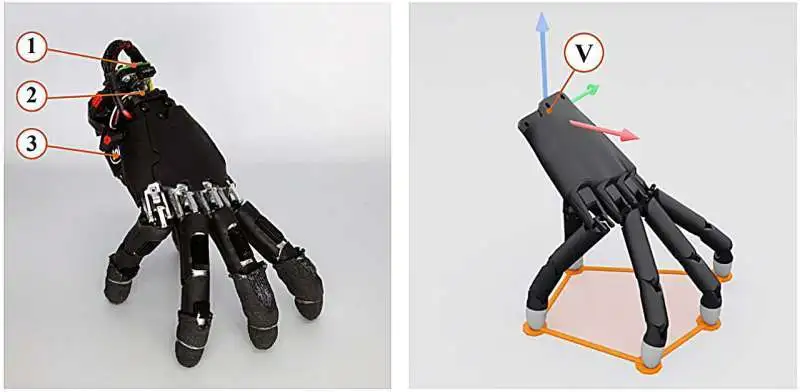
Unlike previous walking robotic hands that relied on symmetrical finger designs, the ETH Zurich team used an off-the-shelf human-like robotic hand featuring uneven fingers and an opposable thumb. While this design is ideal for grasping and handling objects, it creates major challenges for locomotion because each finger has a different reach and contact point.
To overcome these obstacles, the researchers equipped the hand with a battery, motion sensors, and a compact onboard computer. Using reinforcement learning, the robot was trained in simulation to maintain balance, recover from falls, and crawl across complex terrain.
During testing, the robotic hand successfully traversed 14 indoor and outdoor surfaces, including carpet, gravel, grass, and metal grating. In recovery experiments, it regained an upright position in 21 out of 25 trials after being placed on its side.
The system also demonstrated practical interaction skills. While balancing on four fingers, it accurately pressed designated keyboard arrow keys 29 times out of 32 attempts. In another experiment, the robot approached a small block and pushed it to a target location, consistently positioning it within two centimeters of the desired spot.
Researchers believe that giving robotic hands independent mobility could make future robots more adaptable in environments designed for humans, particularly in tight or hard-to-reach spaces where full robotic arms may be impractical.
For readers interested in the latest developments in robotics, AI, soft robotics, autonomous systems, and engineering research, the Science & Tutorials section on the Eriksen platform offers additional scientific insights, technical explainers, and emerging technology coverage from around the world.

