


Summary: South Korean researchers have developed a post-catalytic reaction filtering extraction process that removes degradation-causing lithium ions from perovskite solar cell materials while maintaining high power conversion efficiency. The technology achieved 25.24% efficiency and retained 95% of its initial performance after 1,000 hours of testing at 85°C and 85% relative humidity, offering a promising route toward more durable perovskite and perovskite-silicon tandem solar cells.
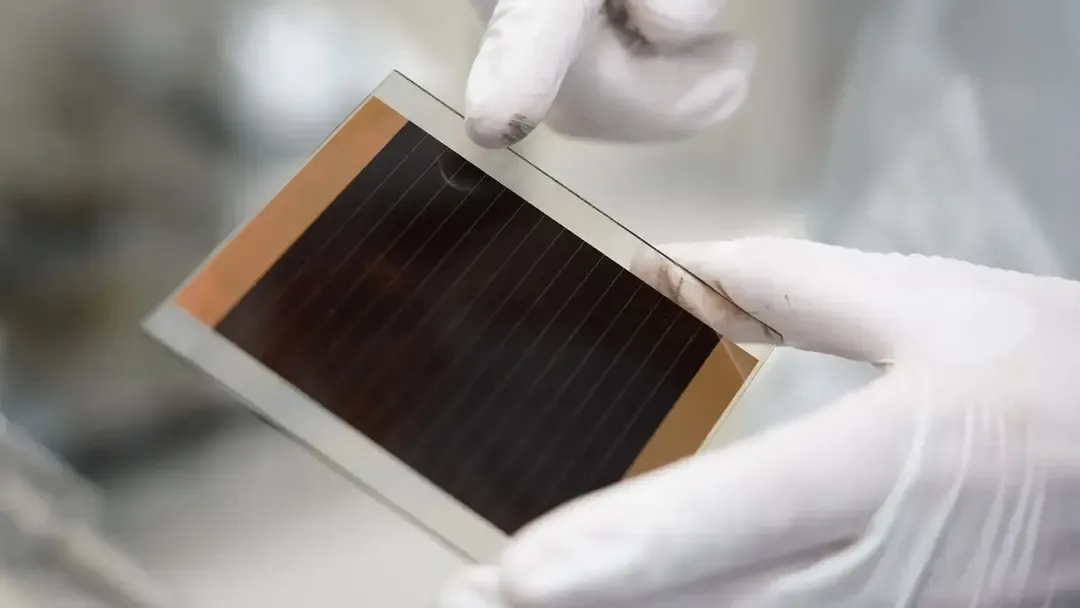
Representative image of a perovskite solar panel.
Perovskite solar cells are emerging as a promising next-generation photovoltaic technology because of their high power conversion efficiency, low manufacturing costs, lightweight structures, and potential for flexible solar panels. However, their sensitivity to heat and moisture has remained a major barrier to commercialization. A South Korean research team has now developed a new post-catalytic reaction filtering extraction process that significantly improves moisture and heat resistance without sacrificing efficiency, potentially advancing the commercialization of perovskite and tandem solar cells.
As thin-film photovoltaic devices, perovskite solar cells rely on light-absorbing perovskite materials to convert sunlight into electricity. Compared with conventional silicon solar panels, which typically have service lifetimes of 25–30 years, conventional perovskite solar cells have reported lifetimes of approximately 2–10 years. Their performance can deteriorate rapidly under hot and humid conditions, undermining long-term reliability, particularly in tropical and subtropical climates.
A major cause of degradation lies in the hole transport layer, a component that helps move positive electrical charges through the solar cell. Conventional manufacturing processes often add lithium salts and other additives to the hole transport layer precursor solution to improve film conductivity and boost power conversion efficiency. However, these additives can become a double-edged sword. Under high-temperature and high-humidity conditions, lithium salts can migrate or redistribute within the film, contributing to microscopic voids and structural defects. Meanwhile, mobile lithium ions can diffuse throughout the device, progressively damaging its internal structure and accelerating performance loss. Researchers have long faced a trade-off: removing lithium salts and additives can significantly reduce conversion efficiency, while retaining them can leave the underlying stability problem unresolved.
To overcome this challenge, a team led by Dr. SeJin Ahn of the Korea Institute of Energy Research (KIER), in collaboration with a research group led by Dr. Dong-Seok Kim at the Ulsan National Institute of Science and Technology (UNIST), developed a post-catalytic reaction filtering extraction process. The method uses nickel oxide (NiOx) powder as a catalyst. When added to the hole transport layer precursor solution, the nickel oxide undergoes a surface reaction that changes its surface properties, enabling it to selectively capture lithium ions. After the catalytic reaction, the lithium ions remain attached to the nickel oxide particles. Because the particles are relatively large, they can then be separated from the solution through a straightforward physical filtration process.
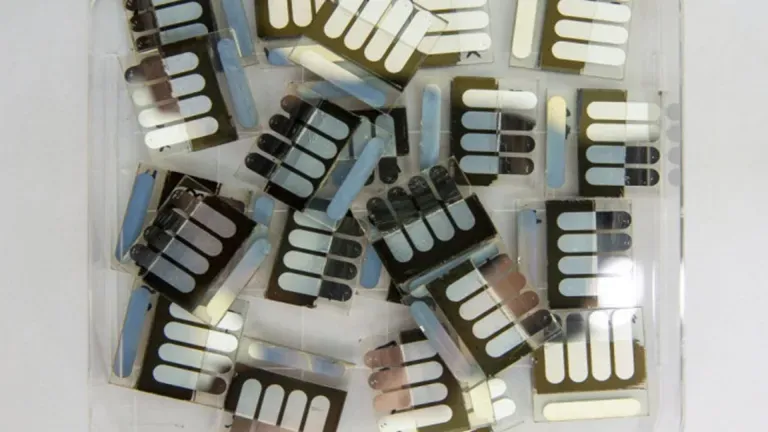
Solar cell sample applying the novel catalytic process technology developed by the Korea Institute of Energy Research (KIER).
After filtration, the resulting precursor solution is free of the targeted harmful additives, residual lithium ions, and catalyst particles. Using this purified solution to fabricate the hole transport layer helps produce a more structurally stable film with fewer defects, addressing lithium-ion migration at its source and potentially slowing device degradation.
The researchers evaluated the technology under demanding accelerated aging conditions: a temperature of 85°C and a relative humidity of 85% for 1,000 hours. The perovskite solar cells fabricated using the new process retained 95% of their initial power conversion efficiency after the test. Importantly, improved stability did not come at the expense of performance. The treated cells achieved a power conversion efficiency of 25.24%, slightly exceeding the 25.21% recorded for conventional cells manufactured using the additive-based approach. The results demonstrate that the process can improve durability while maintaining, and potentially slightly increasing, solar energy conversion efficiency.
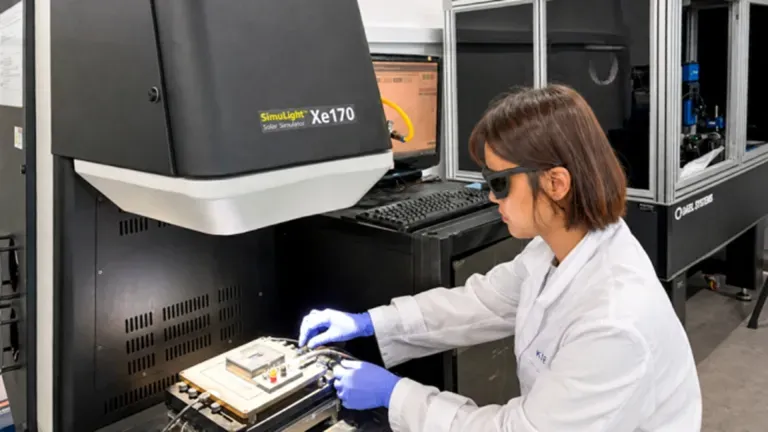
Researchers performing performance tests of the technology.
Dr. SeJin Ahn summarized the significance of the research: “This work breaks away from the conventional framework for perovskite fabrication by using a catalytic approach to induce the necessary doping reactions and then filtering out the substances responsible for degradation.” By addressing a longstanding obstacle to perovskite solar cell durability, the technology could become an important milestone in the commercialization of perovskite and tandem solar cells.
The findings have been published in Advanced Science, introducing an alternative manufacturing strategy for high-stability perovskite photovoltaics and perovskite-silicon tandem solar cells. By combining catalytic treatment with physical filtration, the process offers a potential pathway toward more reliable, high-efficiency solar technology for real-world applications, including installations in hot and humid environments.

