


Summary: Inspired by how octopuses and cuttlefish change color to blend into their surroundings, researchers developed CephCam, an adaptive camouflage system designed to evade AI object detection while remaining visually natural to humans. Published in Nature, the study combines environmental sensing, AI-driven texture optimization, and angle-corrected OLED displays to bring bio-inspired camouflage closer to real-world applications.
How CephCam Bridges Human Vision and AI Camouflage
Octopuses and cuttlefish are masters of natural camouflage. By sensing their surroundings and adjusting skin color and texture, they can blend into sand, coral reefs, and seaweed. Researchers have now translated this biological strategy into CephCam, a closed-loop system that mimics the animal's “eye-brain-skin” mechanism.
Traditional adversarial camouflage faces a fundamental trade-off. Patterns designed to fool AI object detection systems often look unnatural to humans, while conventional camouflage may appear convincing to people but remain easy for deep-learning models such as YOLO and Faster R-CNN to detect. Static printed patterns also struggle to adapt when lighting, viewing angles, or backgrounds change.
CephCam addresses these challenges by integrating a camera as its “eye,” local computing and cloud servers as its “brain,” and an OLED display as its color-changing “skin.” Mounted on a vehicle model, the system continuously adapts its camouflage to the surrounding environment while optimizing two objectives: visual naturalness for humans and reduced detection confidence for AI.
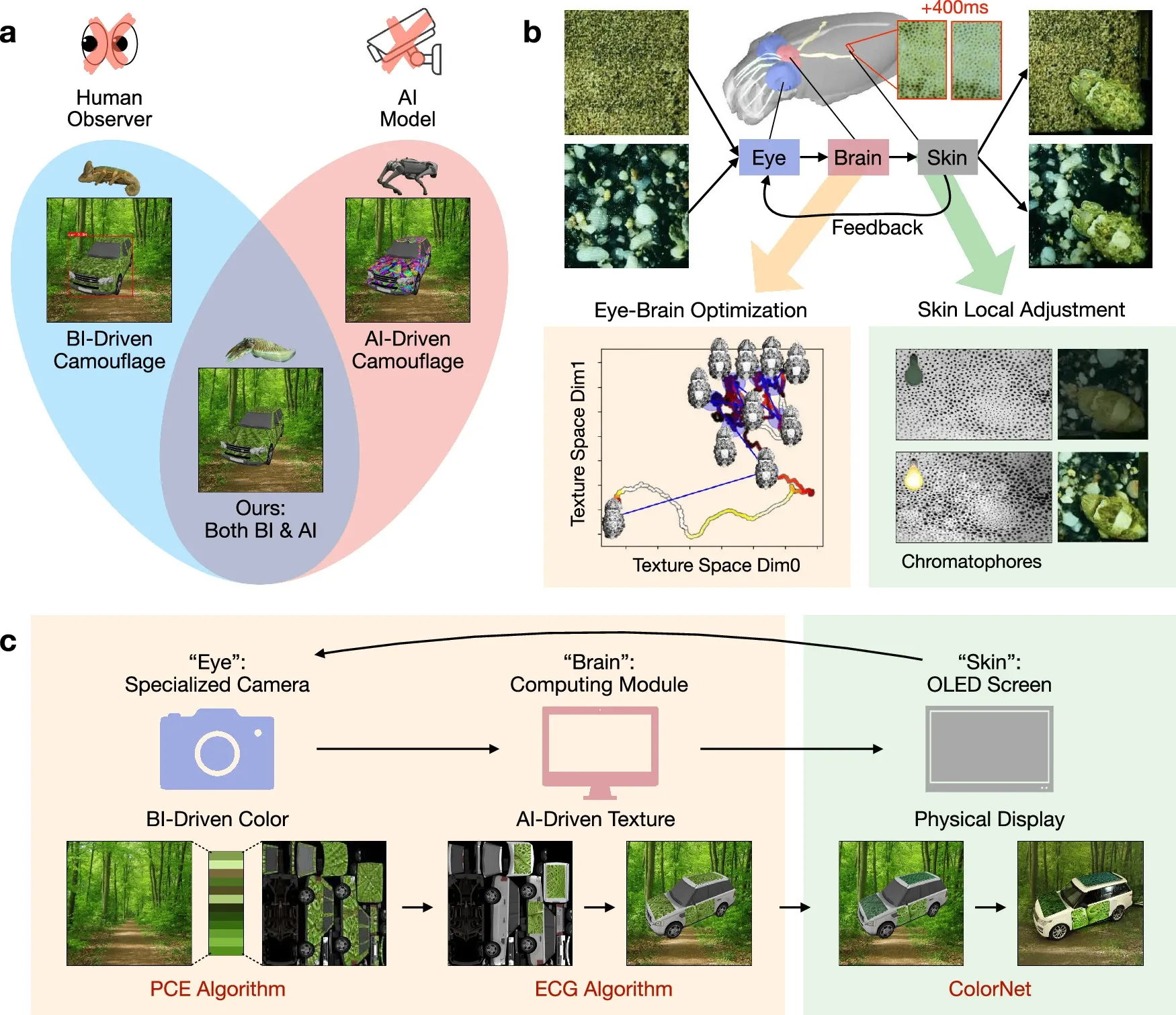 Unifying BI- and AI-driven camouflage with an embodied camouflage system.
AI-Driven Texture Optimization and Adaptive Color Matching
The system uses two core processes: environmental color extraction and joint texture optimization.
First, a camera captures the surroundings, and a palette-based K-means algorithm identifies dominant environmental colors. An environment-aware camouflage generation algorithm then optimizes the texture, using Gumbel-Softmax to enable differentiable color assignment and mapping the resulting pattern onto a 3D vehicle model.
The optimization balances three objectives: reducing object detector confidence, suppressing classification scores, and maintaining smooth, natural-looking patterns. This approach aims to produce camouflage that is difficult for both human observers and AI vision systems to identify.
The researchers also developed ColorNet to address a hardware challenge. OLED displays can exhibit color shifts when viewed from different angles, creating discrepancies between simulated camouflage and its physical appearance. By learning the relationship between viewing angles and color deviations, ColorNet compensates for these shifts and improves consistency across viewing conditions.
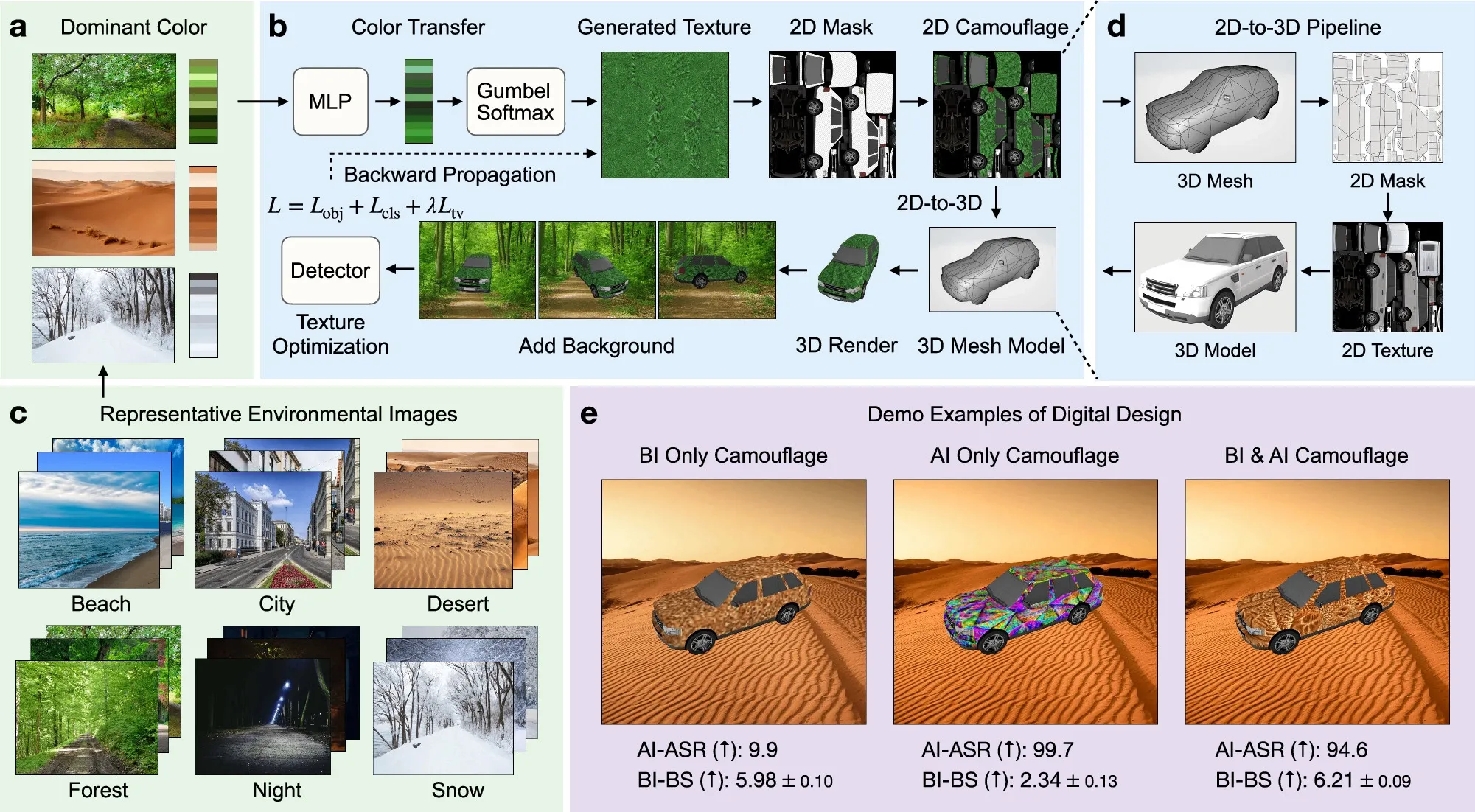
Digital design of camouflage patterns.
Two Operating Modes Balance Speed and Performance
CephCam supports two modes to accommodate changing environments.
Template-matching mode: The local system compares environmental colors with a library of pre-generated camouflage patterns and selects the closest match using the CIEDE2000 color-difference formula. Switching takes approximately 0.4 seconds, making it suitable for rapid environmental changes.
Real-time learning mode: Cloud-based GPUs iteratively optimize a new pattern for the current scene. Each optimization cycle takes around 2.5 minutes, but can deliver stronger camouflage performance and greater visual naturalness. Successful patterns can be added to the template library for future use.
To improve robustness against unfamiliar AI detectors, the researchers jointly optimized camouflage against three representative architectures: YOLOv9, Faster R-CNN, and Deformable DETR. The resulting patterns also showed improved attack success rates against models excluded from training, including YOLOX, Mask R-CNN, and DINO.
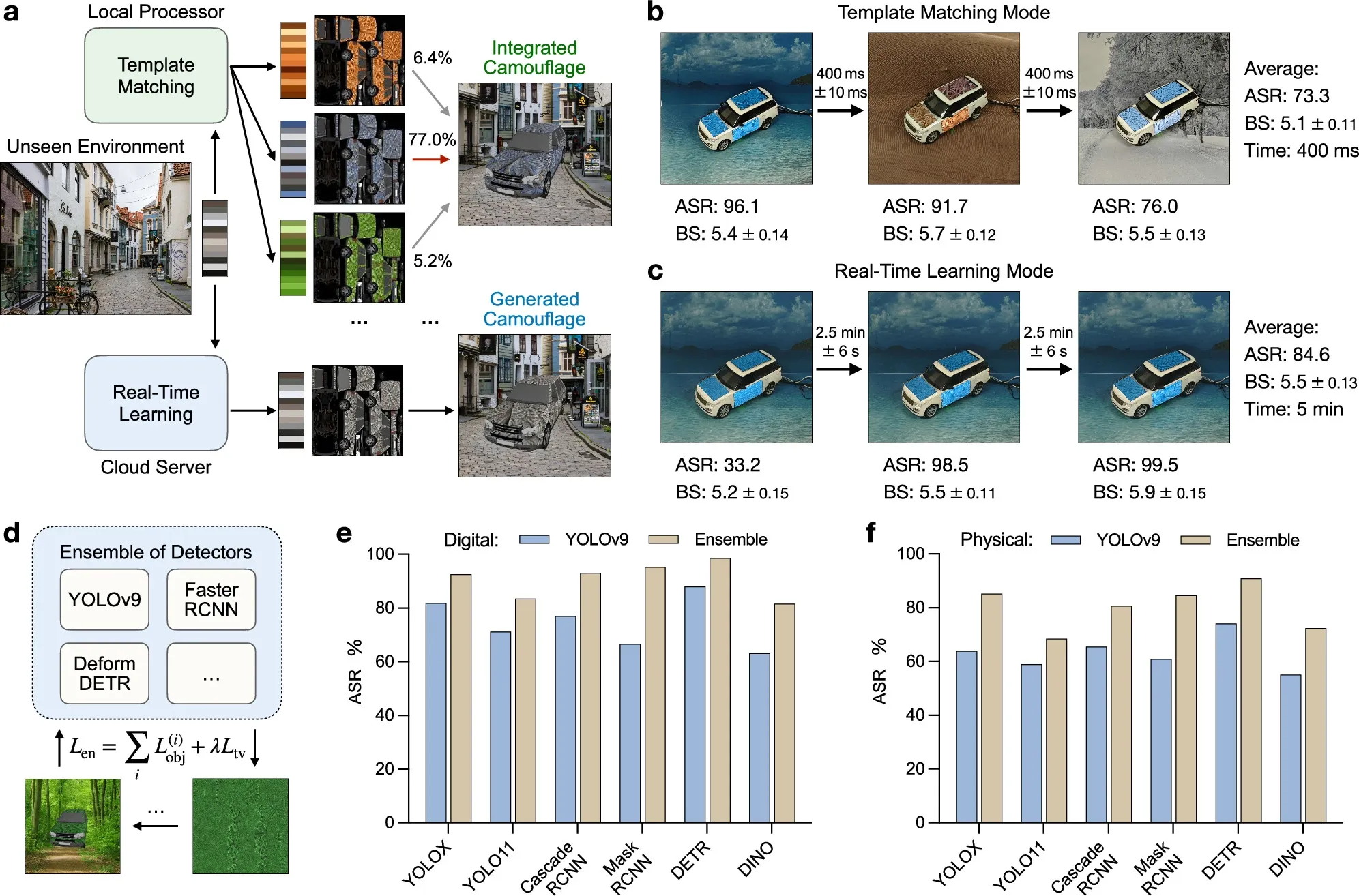
Improving spatial and temporal adaptability of camouflage patterns.
Experiments Show Promise Against Human and Machine Detection
The researchers evaluated CephCam across six environments: beaches, cities, deserts, forests, nighttime scenes, and snowy landscapes. Human-subject studies complemented the technical evaluations.
The experiments measured attack success rate (ASR) to assess AI evasion and a blending score (BS), rated on a seven-point scale, to evaluate how naturally the camouflage appeared to human observers.
The results supported the system's combined optimization strategy. Camouflage optimized only for human vision looked natural but remained vulnerable to AI detection. Patterns optimized only against AI were more effective at evading detectors but often appeared conspicuous to people. The complete CephCam system achieved strong results on both measures across the tested environments.
Human visual-search experiments also found that CephCam reduced participants' target detection rates and increased their identification times, suggesting that its effectiveness extends beyond static image comparisons.
Applications and Remaining Challenges
Beyond vehicle camouflage, the research highlights a broader finding: human vision and deep-learning vision may share certain perceptual vulnerabilities. Some textures can blend into the visual context perceived by humans while disrupting the features used by AI detectors, offering a new experimental framework for studying biological and machine vision.
Potential applications include adaptive vehicle camouflage, flexible-display systems, and privacy-oriented technologies designed to reduce unauthorized automated visual tracking. However, practical deployment still faces limitations. Current prototypes cover only part of a vehicle because of commercial OLED display size constraints, while complex real-time optimization depends on cloud computing and can introduce latency.
The wider significance of CephCam lies in its embodied, closed-loop design. Rather than generating an adversarial image in isolation, it connects environmental sensing, computation, and physical display hardware to adapt camouflage to real-world conditions.
By turning the camouflage strategies of octopuses and cuttlefish into an engineering blueprint, CephCam points toward a new direction for bio-inspired AI, adaptive camouflage, adversarial machine learning, and computer vision security.

