


Lead: Researchers have developed a bio-inspired robot that can grow functional light sensors directly onto its body using an artificial circulatory system to transport chemical materials. In a moth-shaped robot demonstration, ultraviolet (UV) light triggered sensor formation on demand, enabling the robot to flap its wings or activate an LED.
Inspired by the Insect Circulatory System
Most robots are built with fixed sensors whose types and positions are determined before deployment. Engineers must anticipate operating conditions in advance and decide which sensors to install and where to place them. Although insect-inspired robots can respond to unexpected environments, they still face a fundamental limitation: they cannot easily acquire new physical sensing hardware after deployment.
To address this challenge, a research team from the University of Tartu in Estonia and the Italian Institute of Technology (IIT) turned to the open circulatory system of insects. Insects use hemolymph to transport substances throughout their bodies, delivering materials to different tissues and organs. The researchers also drew inspiration from the flat wings of the blue underwing moth (Catocala fraxini), where circulation primarily occurs in a two-dimensional plane, making it easier to simplify the robot's internal fluid channels.
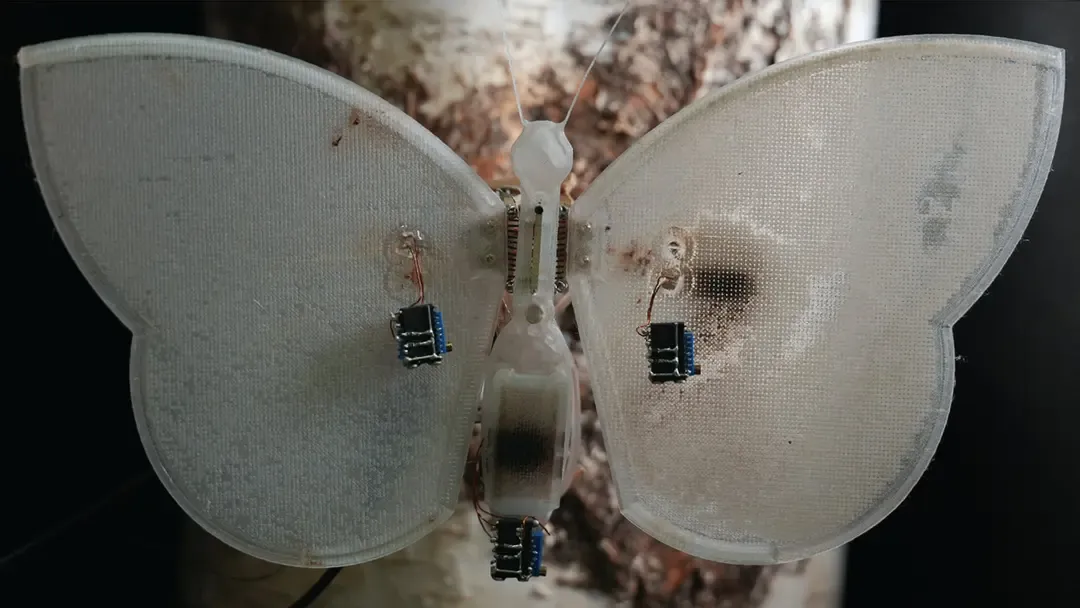
The team 3D-printed a transparent moth-shaped robot using PETG plastic. Each wing covers 86 square centimeters and contains millimeter-wide channels resembling natural leaf veins. Smaller gaps between printed lines form a network of microchannels, allowing liquid to penetrate approximately 10 micrometers into the surrounding material. A pump circulates around 3 milliliters of liquid throughout the robot, delivering chemical ingredients to selected locations.
UV Light Turns Transparent Plastic into Functional Sensors
The researchers added pyrrole, a photoactive chemical initiator and a cellulose-based additive called CAP to an artificial hemolymph solution. The mixture flows through internal microchannels and permeates the surrounding plastic. When a selected area is exposed to UV light for approximately one minute, pyrrole polymerizes into polypyrrole, an electrically conductive polymer. The transparent plastic gradually turns black at the illuminated location, visibly forming a new functional material.
Using a template, the researchers can control the sensor's shape and position with a precision of 0.3 millimeters. The resulting material temporarily changes its electrical properties under UV exposure, reducing its impedance. An onboard microcontroller detects the resulting signal and can activate shape-memory alloy wires to flap the robot's wings or switch on an LED. In effect, the robot gains sensing capabilities that were not built into it during manufacturing.
"You could, of course, use an off-the-shelf photodiode, but you would need to know exactly where to put it. When robots enter more dangerous and complex environments, it is difficult to predict those requirements in advance. Growing receptors on demand means the environment itself can help pattern the robot based on what is actually happening," said lead researcher Kadri-Ann Pankratov, a PhD student at the University of Tartu.
The team also observed an unexpected effect: the sensors became increasingly sensitive after repeated UV exposure. Residual pyrrole continued to polymerize, producing additional polypyrrole structures and changing the sensors' electrical properties. The researchers describe this phenomenon as a form of "material memory," in which the sensor's physical structure retains a record of previous exposure. The sensors remained functional even after more than four months in storage.
A Proof of Concept for Self-Growing Robotic Hardware
The demonstration remains at the proof-of-concept stage. It relies on a single predefined chemical reaction, and sensor formation is irreversible. Researchers must also control when the chemical mixture enters the robot and use templates to determine where new sensors develop. The robot cannot yet autonomously identify which new hardware it needs or invent its own manufacturing process.
Nevertheless, the approach could eventually help robots adapt to challenging environments, including forests, collapsed buildings, underwater settings and even other planets. The same circulatory network could potentially transport different chemicals to produce corrosion-resistant materials, electromagnetic shielding or interfaces with living tissues. The researchers also hope to develop reversible chemical systems.
The next challenge is reducing dependence on predefined instructions. "Right now, the central intelligence of the robot knows which components are coming. How do we make it so that this does not have to be predetermined? We do not yet have a very good source of inspiration for this in biology," Pankratov said.
She hopes artificial blood and circulatory systems could become a mature robotics technology within the next decade, allowing machines to develop new capabilities in response to their environments.
The research was published in the journal Advanced Science.

