


Summary: Cadence has introduced Maestro, a portfolio of domain-specific AI models designed to power EDA AI superagents for semiconductor and system design. According to internal benchmarks, the platform delivers up to 30% higher design quality and 5× greater token efficiency compared with general-purpose foundation models, accelerating AI-driven chip design and verification workflows.
Cadence has introduced Maestro, a new portfolio of domain-specific artificial intelligence (AI) models designed to transform electronic design automation (EDA) and semiconductor engineering. The technology provides the underlying intelligence for Cadence's EDA AI superagents, aiming to improve chip design productivity, optimize engineering workflows, and accelerate the development of increasingly complex semiconductor systems.
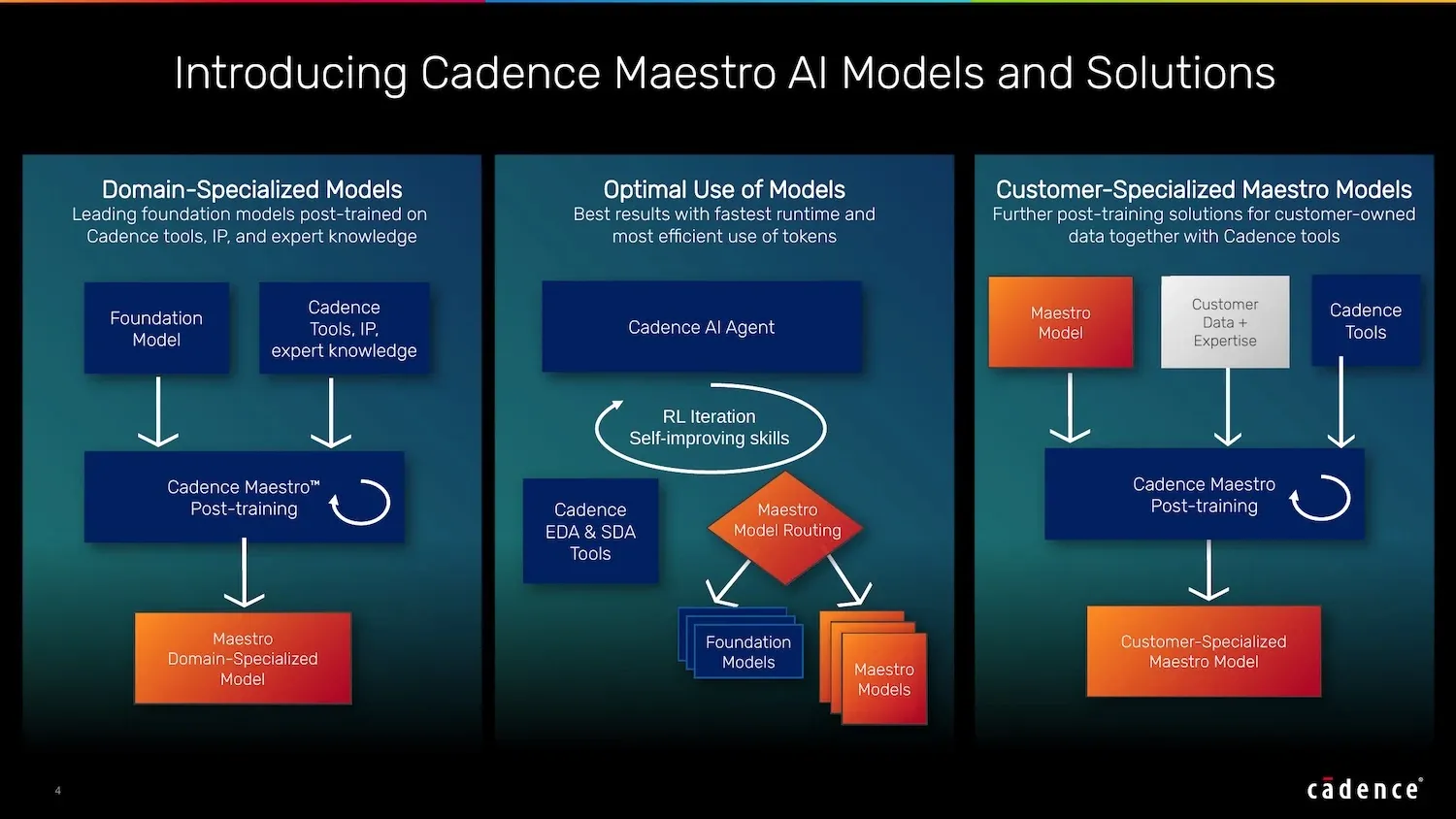
Maestro combines post-trained large language models (LLMs), decision-trained models, and self-improving agent skills. According to Cadence's internal benchmarks, the platform achieves up to 30% higher design result quality and up to 5× greater token efficiency compared with general-purpose foundation models. These figures are based on company-conducted tests and have not been independently audited by a third party.
Its performance advantages stem from a vertically integrated, closed-loop learning architecture that connects Maestro models with AI superagents, EDA and system design automation (SDA) tools, curated engineering datasets, and evaluation frameworks. Deterministic EDA solvers assess agent-generated outputs against engineering metrics, design constraints, and benchmark ground truth, creating a verifiable reinforcement learning feedback loop that helps AI agents make more reliable engineering decisions.
Cadence's AI superagents use a collaborative architecture that combines Maestro with general-purpose AI models. After receiving high-level design objectives, an agent interprets engineering requirements, breaks down complex tasks, and dynamically coordinates Maestro with leading proprietary and open-source models. It then connects to EDA and SDA tools to execute design workflows. By intelligently allocating model inference and tool calls, the system aims to reduce token consumption while improving overall computational efficiency.
Customers can also use their own engineering datasets and business workflows to further post-train Maestro models, including models from the NVIDIA Nemotron family, enabling customization for specific semiconductor design requirements.
NVIDIA is supporting the initiative with Nemotron models and engineering expertise. The two companies are also integrating Cadence's AI agents with NVIDIA OpenShell's reference architecture to strengthen agent security. NVIDIA said reinforcement learning based on feedback from EDA tools and deterministic solvers can guide AI agents toward chip design decisions that better satisfy real-world engineering constraints.
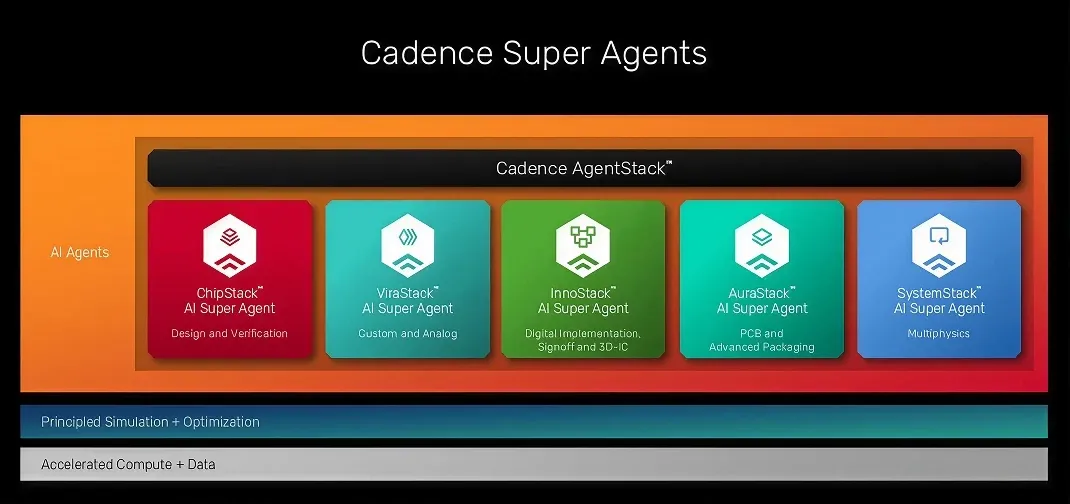
Four specialized AI superagents cover different stages of the semiconductor design workflow. ChipStack focuses on digital front-end design and verification; ViraStack targets custom circuit and analog design; InnoStack supports digital implementation, signoff, and 3D-IC design; and AuraStack handles printed circuit board (PCB) design and advanced packaging. These agents are coordinated by AgentStack, the central orchestration agent responsible for managing the overall workflow.
Early industry deployments have already demonstrated the technology's potential. Socionext has introduced InnoStack into its production design environment, targeting productivity improvements of up to 5× while maintaining design quality. Meanwhile, Silicon Labs is using the Verisium Debug tool within ChipStack to accelerate root-cause analysis and end-to-end debugging in pre-silicon low-power verification workflows.
The Cadence Maestro AI superagent platform supports flexible deployment options, including Cadence's dedicated secure cloud, public cloud environments, and customer-operated on-premises infrastructure. This flexibility allows semiconductor companies to accommodate different data privacy, security, and enterprise IT requirements.
The first Maestro models are scheduled to become available to selected early-access customers in the fourth quarter of 2026. Cadence has not yet announced general availability dates or pricing details.

