


Summary: Researchers have developed an ultra-fast artificial olfaction technology that uses in-sensor analog differential circuits to extract gas concentration information directly from the initial stage of adsorption. By bypassing the need for adsorption equilibrium, the approach accelerates gas concentration readout by 10–1,000 times, opening new possibilities for real-time gas detection, mixed-gas identification, and drone-based leak monitoring.
A major challenge in conventional gas sensing is the time required for sensors to reach adsorption equilibrium before producing reliable measurements. A new study published in Nature Sensors introduces a different approach: instead of waiting for gas molecules to fully interact with a sensing material, the system extracts useful information from the earliest changes in the sensor's electrical response.
Traditional resistive gas sensors typically determine gas concentrations by measuring resistance changes after gas adsorption approaches equilibrium. This process can take tens of seconds or even longer, limiting their effectiveness in applications requiring rapid detection. The new technology moves the measurement point forward to the initial adsorption stage, using a pseudo-first-order adsorption kinetics model to establish a relationship between gas concentration and the rate of transient resistance change. Because the initial resistance response rate is concentration-dependent, useful information can be obtained before the sensor reaches a stable state.
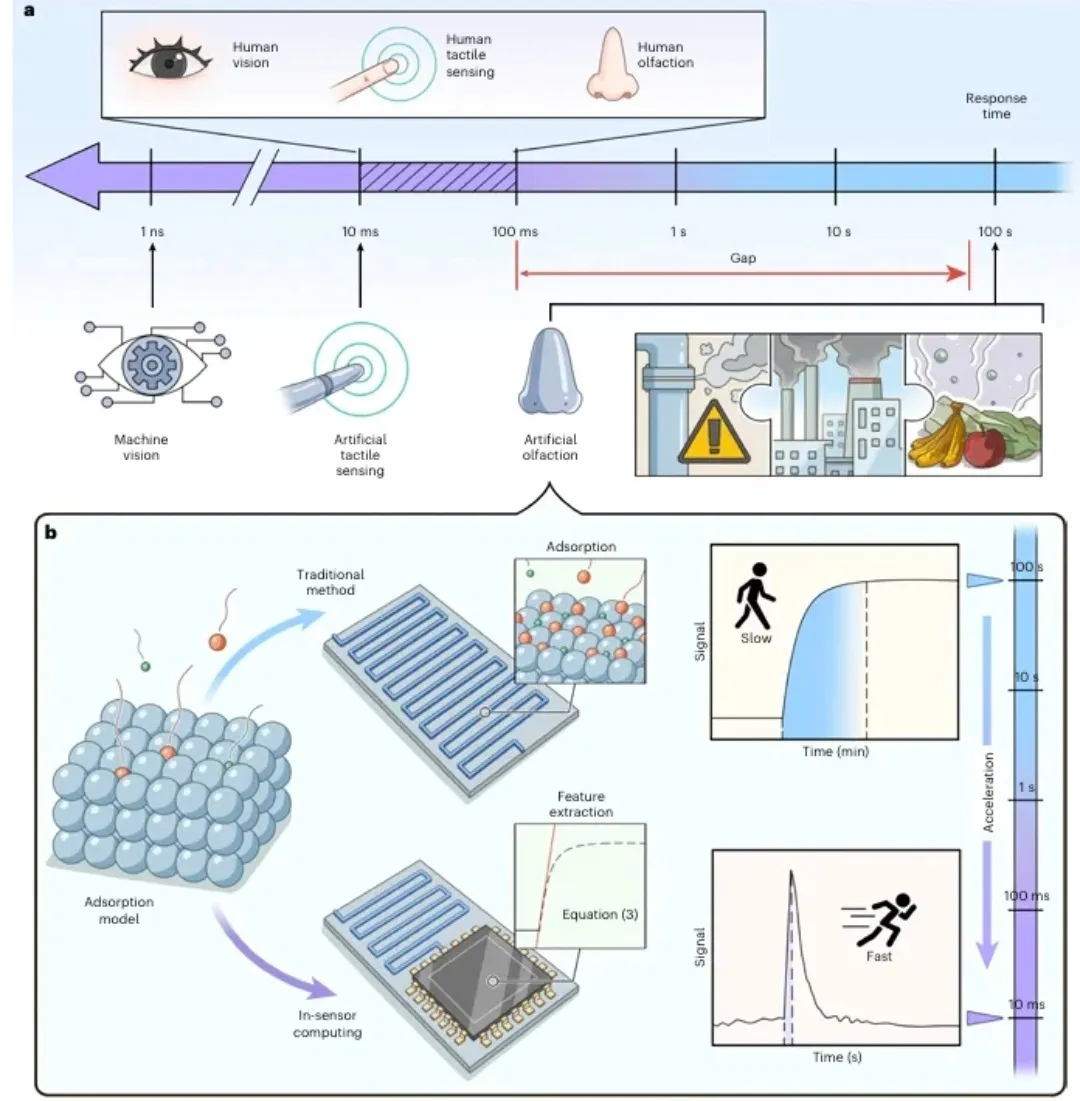
A comparison of response times between human and artificial olfaction, and a distinction between traditional equilibrium gas detection and sensor-internal dynamic feature extraction strategies.
To implement this approach, researchers designed an in-sensor analog differential circuit that directly processes transient resistance signals from gas-sensitive materials. The circuit performs differential operations and converts the extracted kinetic features into a characteristic output voltage. Rather than collecting an entire adsorption-response curve and sending it to an external computer for complex curve fitting, the system extracts key features directly at the sensor level.
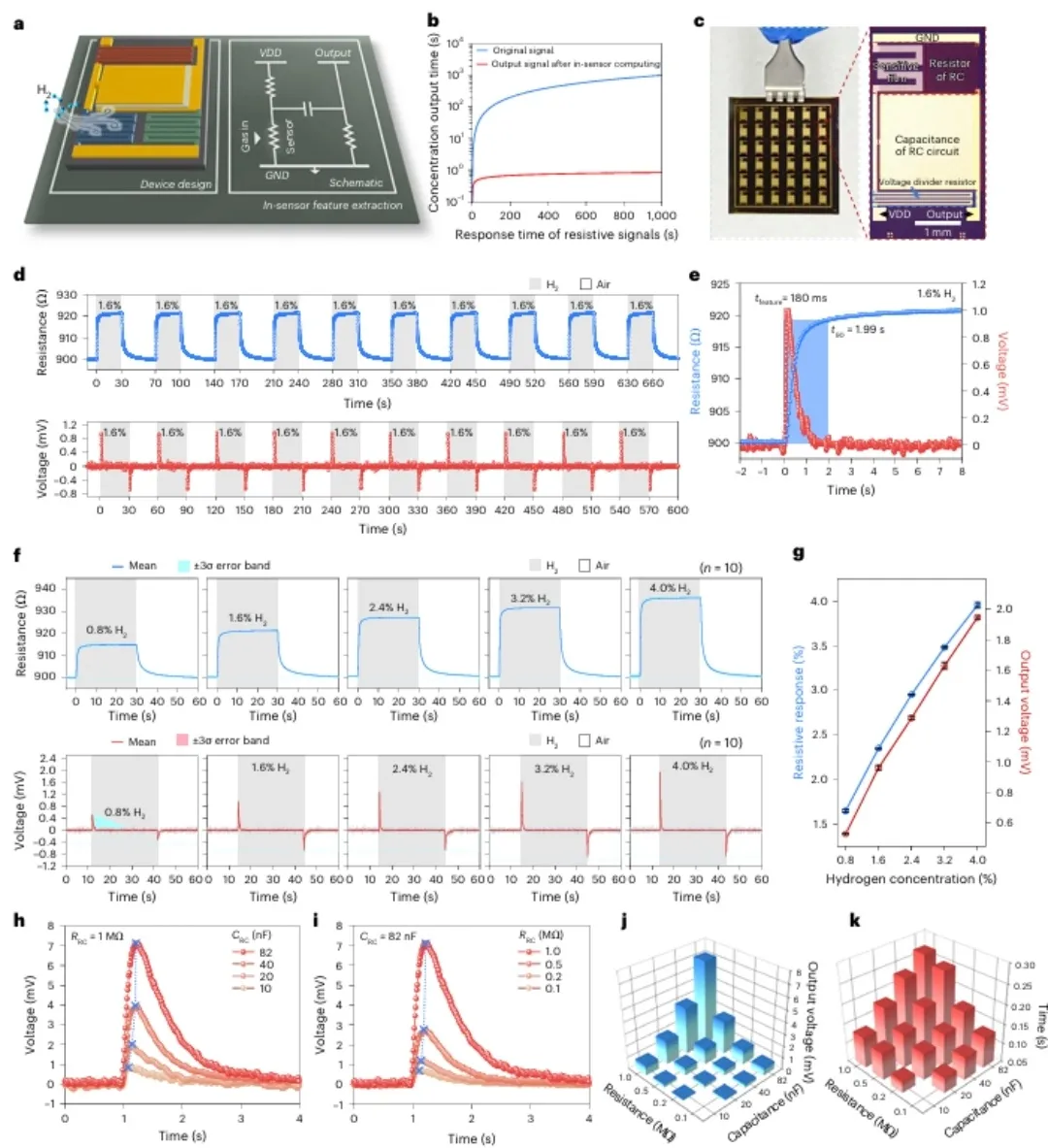
Design of feature extraction circuit within the sensor, pseudo-first-order adsorption kinetics, transient response of hydrogen and rapid concentration output performance
This hardware-based approach reduces data-processing delays while potentially minimizing the noise and computational overhead associated with high-frequency digital sampling. In hydrogen detection experiments, the circuit successfully extracted stable transient features and generated concentration-related output signals within a much shorter time. Following calibration, the characteristic voltage could be mapped to gas concentration, enabling rapid quantitative detection.
The researchers also evaluated the method across different resistive gas-sensing materials and target gases, including hydrogen (H₂), ammonia (NH₃), and nitrogen dioxide (NO₂). Experimental results demonstrated that, with appropriate calibration, initial-stage adsorption features could support rapid concentration estimation across multiple sensor types. This indicates that the approach is not restricted to a particular sensing material. Instead, it provides a general-purpose signal-processing architecture that shifts part of the gas-sensing speed challenge from material response to circuit and computational design.
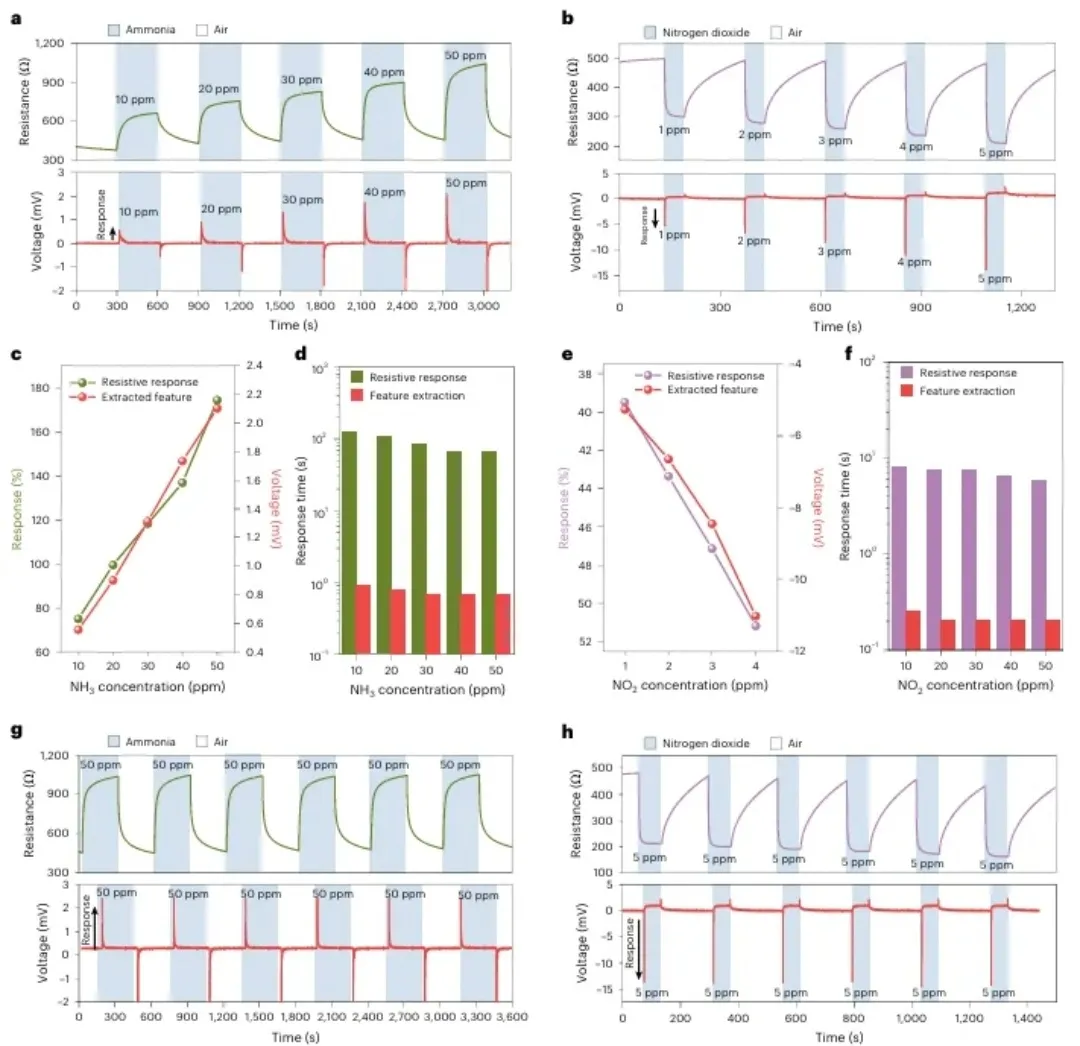
The applicability of the feature extraction structure within the sensor to different gas-sensitive materials and gas detection, as well as the rapid response results for gases such as ammonia and nitrogen dioxide.
For more complex environments, the team extended the system to mixed-gas detection. A multi-sensor array was used to collect conventional resistance signals and in-sensor extracted kinetic features from samples containing different gas compositions and concentrations. By examining how different gas mixtures were distributed in the resulting feature space, the researchers assessed their distinguishability.
The extracted transient features retained information about gas composition and concentration, making them suitable inputs for machine learning models. Combining rapid hardware-level feature extraction with machine learning analysis enabled mixed-gas identification while reducing dependence on complete adsorption-response curves. This approach could help address cross-sensitivity, a persistent challenge in electronic nose systems.
To demonstrate its practical potential, the researchers integrated the technology into a drone and tested it in a simulated gas-leak environment. During flight, the system monitored localized changes in gas concentration, demonstrating its ability to provide rapid concentration information under dynamic operating conditions. Such capabilities could support the identification of abnormal gas concentrations and potential leak locations in environments where stationary monitoring systems are less effective.
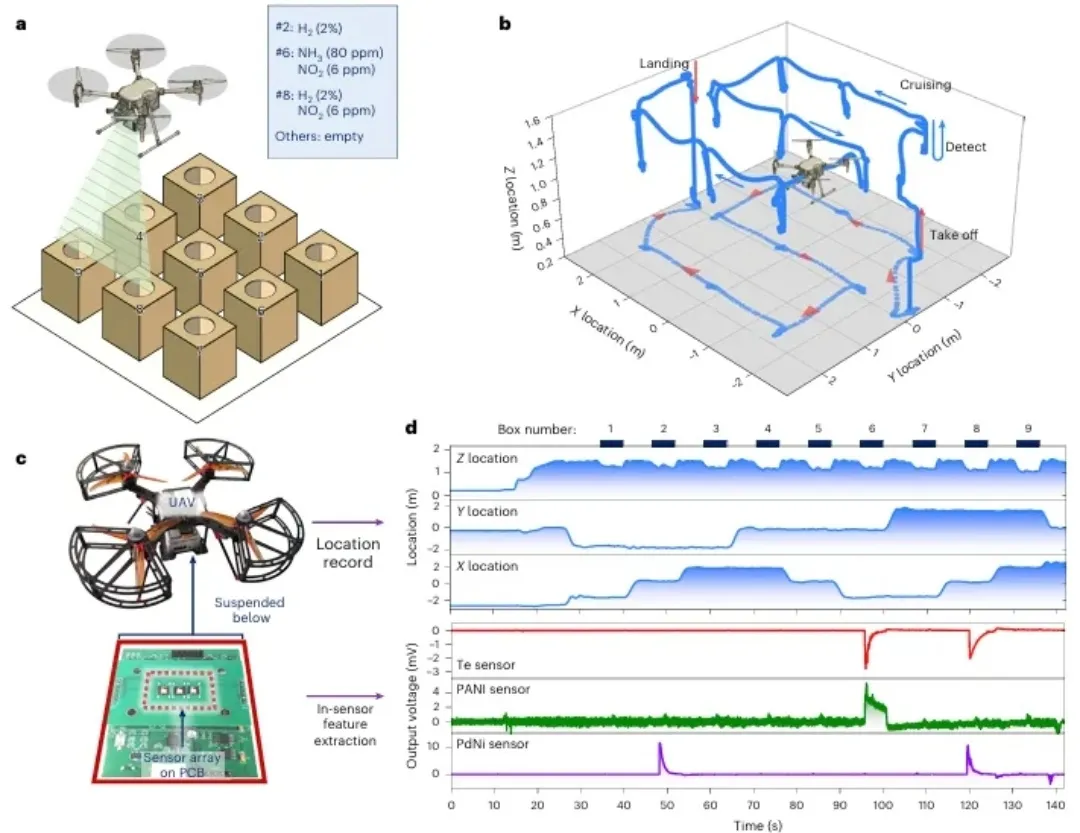
The results of drones equipped with ultra-fast artificial olfaction systems, simulated gas leak experiments, dynamic concentration monitoring, and autonomous cruise detection.
Overall, the study demonstrates how in-sensor computing, analog differential circuits, adsorption kinetics, and machine learning can work together to accelerate artificial olfaction. By extracting concentration-related information from the earliest stage of gas adsorption, the technology offers a promising pathway toward millisecond-scale gas sensing, real-time environmental monitoring, industrial leak detection, and mobile robotic perception.

