


Summary: Researchers in China have developed a long-life aqueous zinc-ion battery by modifying cathode surface chemistry with hydroxyl functional groups. The battery retains 89.34% of its initial capacity after more than 10,000 charge-discharge cycles, demonstrating a promising approach to improving the durability of zinc-iodine energy storage systems.
Representational image of liquid battery testing.
Rethinking Cathode Chemistry to Overcome Battery Degradation
Aqueous zinc-ion batteries (ZIBs) are attracting attention as potential alternatives for large-scale energy storage because of their safety, low cost, and the natural abundance of zinc. Many existing designs use iodine-based cathodes, which offer relatively stable cycling performance, fast charge-discharge capabilities, and considerable energy storage potential.
However, iodine-based cathodes still face several challenges, including poor electrical conductivity, structural changes during charge-discharge processes, and the migration of iodine species between electrodes, known as the shuttle effect. These issues reduce energy efficiency, accelerate material degradation, and ultimately shorten battery lifespan.
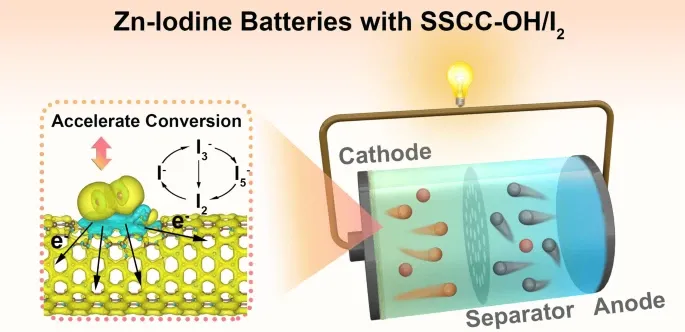
To address these limitations, researchers from Jilin University and the Changchun Institute of Applied Chemistry, Chinese Academy of Sciences, focused on modifying cathode functional-group chemistry rather than relying solely on changes to the electrolyte or battery structure. Their approach resulted in a self-supporting carbon nanotube cathode (SSCC).
Hydroxyl-Modified Carbon Nanotubes Act as Anchors for Iodine
The research team compared the iodine adsorption capabilities of unmodified carbon nanotubes and nanotubes functionalized with hydroxyl (‒OH), carboxyl (‒COOH), and amino (‒NH₂) groups to identify the most effective surface chemistry.
Spectroscopic and microscopic analyses confirmed that the functional groups had been successfully introduced and that iodine was uniformly distributed throughout the cathode material.
Among the different modifications, hydroxyl-functionalized carbon nanotubes delivered the best performance. Their hydroxyl groups act as microscopic chemical anchors, helping immobilize iodine species within the cathode instead of allowing them to migrate through the battery.
This surface-chemistry strategy suppresses iodine loss, reduces energy dissipation, and improves both battery efficiency and long-term cycling stability.
Key Performance: 89.34% Capacity Retention After 10,000 Cycles
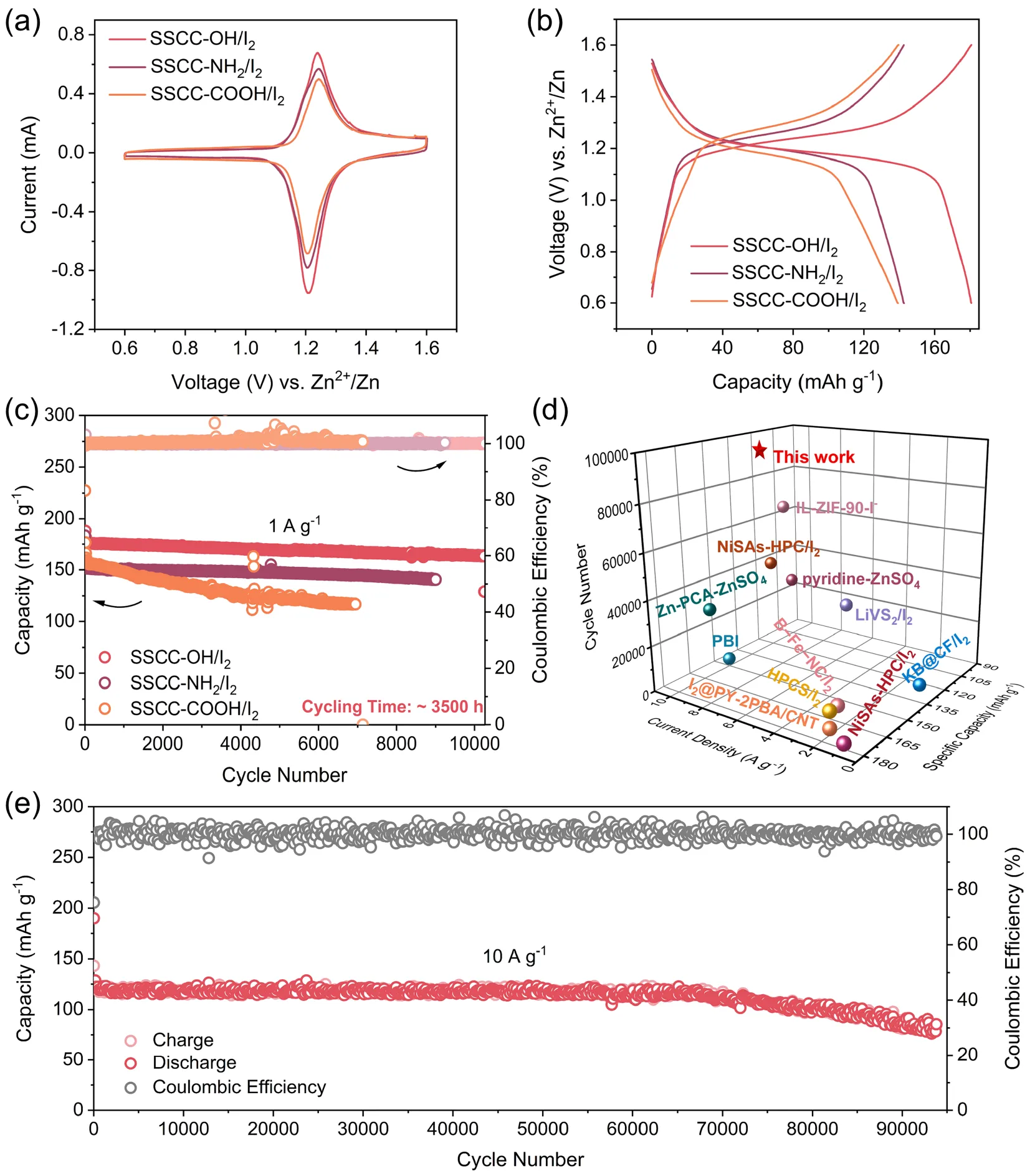
Laboratory tests demonstrated the cathode's strong charge-storage capability and cycling durability. At a current density of 1 A/g, the battery achieved an initial reversible capacity of 175.5 mAh/g.
More importantly, it retained 89.34% of its initial capacity after more than 10,000 charge-discharge cycles.
At a higher current density of 10 A/g, the battery still delivered a capacity of 120 mAh/g and achieved an exceptionally long cycle life of 93,400 charge-discharge cycles.
Using in situ Raman spectroscopy and ex situ X-ray photoelectron spectroscopy (XPS), the researchers further confirmed that iodine species underwent repeated and reversible transformations during charging and discharging. The modified cathode effectively suppressed the iodine shuttle effect and prevented iodine species from becoming trapped in the electrolyte.
Scaling Up: A 150 mg Iodine Pouch Cell Demonstrates Practical Potential
To evaluate the technology beyond laboratory-scale testing, the team developed a larger pouch-cell prototype containing 150 mg of iodine.
The prototype operated at a voltage of 1.1 V and delivered an actual capacity of 23.8 mAh. After 350 charge-discharge cycles, it retained 91.7% of its initial capacity, demonstrating promising durability under conditions closer to practical battery applications.
The researchers suggest that controlling cathode functional-group chemistry offers a relatively simple and effective way to improve iodine conversion kinetics and stabilize aqueous zinc-iodine batteries.
The strategy could provide a new direction for developing long-life aqueous energy storage systems based on abundant zinc metal, with potential applications in large-scale stationary energy storage.
Follow Eriksen for more international science and technology news.

