


Summary: Researchers at the Korea Advanced Institute of Science and Technology (KAIST) have developed a liquid crystal polymer (LCP) battery separator that reduces lithium-ion transport pathway tortuosity by approximately 2.5 times and suppresses lithium dendrite formation. Lithium-metal batteries using the separator retained 94% of their initial capacity after 100 cycles at a 4C charging rate, equivalent to approximately 15-minute charging. The findings were published in ACS Nano.
Lithium-metal batteries offer high energy density but face a major challenge: lithium dendrites can form during charging, penetrating the separator and potentially causing internal short circuits or fires. Preventing dendrite growth remains a key obstacle to their commercialization.
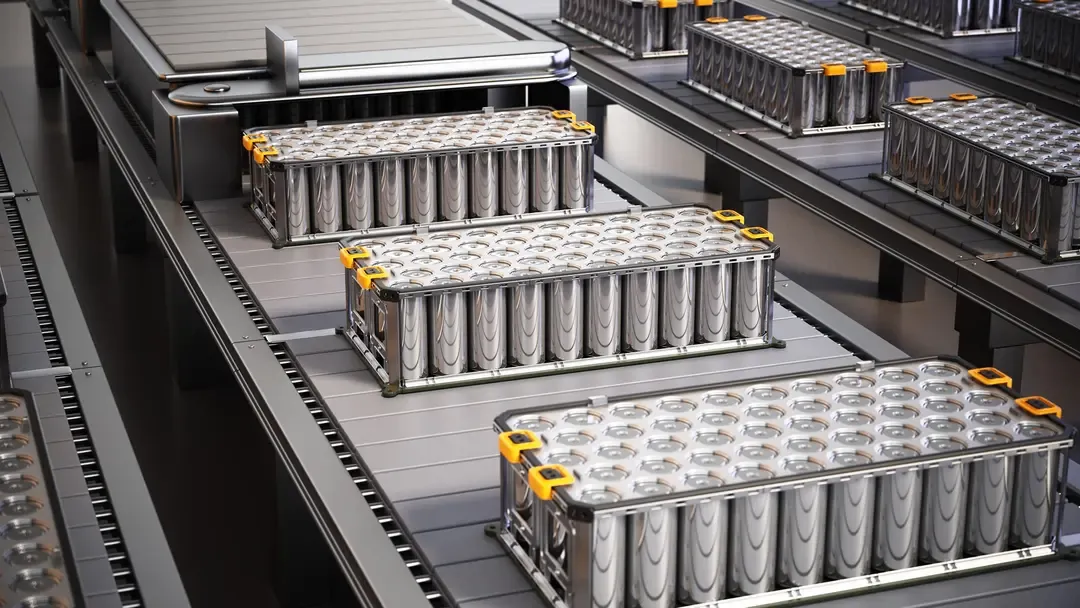
Representative image of lithium-ion battery packs placed on a production line in a manufacturing facility.
A research team led by Professors Dong Ki Yoon and Hye Ryung Byon from KAIST's Department of Chemistry has developed a new approach that controls lithium-ion transport through the battery separator itself. The research was published in ACS Nano under the title Directional Li Flux Control via Liquid-Crystalline.
Liquid Crystal Alignment Creates Direct Ion Transport Channels
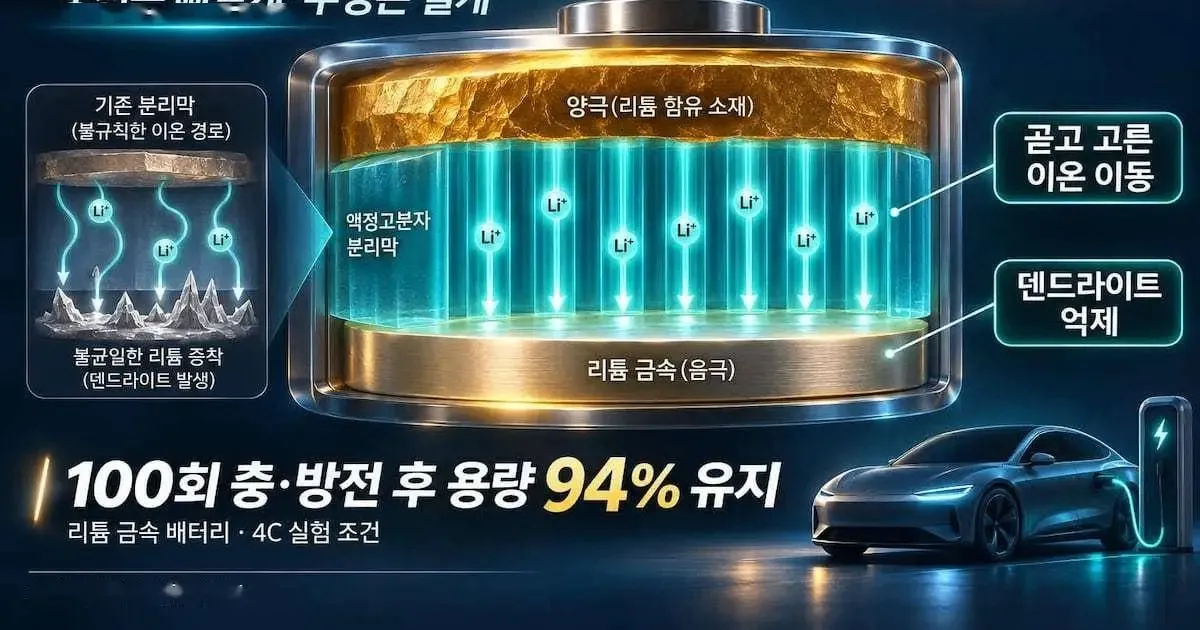
Conventional battery separators contain randomly distributed microscopic pores, forcing lithium ions to travel along winding pathways. Uneven ion distribution can lead to localized lithium accumulation and dendrite formation.
The KAIST team developed a separator using liquid crystal polymers (LCPs), incorporating polyethylene glycol (PEG) chains to improve ion transport. Researchers compared two configurations in which liquid crystal molecules were aligned vertically or horizontally.
The vertically aligned structure created more direct pathways for lithium ions to reach the electrode, reducing ion transport pathway tortuosity by approximately 2.5 times compared with the horizontally aligned configuration. More uniform ion distribution helped suppress localized lithium accumulation and dendrite growth.
94% Capacity Retention After 100 Cycles at 4C
In full-cell testing, lithium-metal batteries equipped with the new separator retained 94% of their initial capacity after 100 charge-discharge cycles at a 4C rate, equivalent to a theoretical charging time of approximately 15 minutes.
"Molecular alignment plays a critical role in battery performance," Professor Yoon said.
The researchers believe this approach could support next-generation high-energy-density batteries designed to combine longer driving ranges with faster charging.
Potential for Next-Generation EV Batteries
The study introduces an alternative strategy for suppressing lithium dendrites by engineering the separator's microscopic structure to regulate ion transport, rather than relying solely on electrolyte modifications or protective electrode coatings.
This approach could have implications for fast-charging lithium-metal batteries and electric vehicle (EV) energy storage. However, the current results come from laboratory-scale cells. Further validation is needed in larger-capacity batteries, thicker electrodes, and long-term operation under varying temperatures.
Manufacturing scalability, material costs, and production consistency will also determine whether the technology can advance toward commercial battery applications.

