


Summary: Researchers at the University of Michigan have developed PRISM, a new neural network input module that improves robot control by explicitly modeling physical interactions. Without increasing model size or adding force sensors, the technology raised simulated humanoid robot stability from 51% to 92.5% and improved real-world robotic grasping success from 68% to 94%. The findings were presented at CoRL 2026.
Robot control has traditionally relied on neural networks such as multilayer perceptrons (MLPs), originally designed for general-purpose tasks like image recognition. However, unlike static images, robots continuously change their physical environment through movement, creating complex feedback loops between joint positions, velocities, forces, and sensor readings.
Researchers from the University of Michigan College of Engineering have challenged this conventional approach with PRISM (Polynomial Representations for Interaction-Structured Motor Control), presented at the 10th Conference on Robot Learning (CoRL 2026).
PRISM replaces only the neural network's initial input-processing layer. It automatically learns multiplicative relationships among robot observations, previous actions, and task commands, allowing the controller to better represent physical interactions without manually programmed physics equations or additional sensors. Existing training methods and controller architectures can remain unchanged.
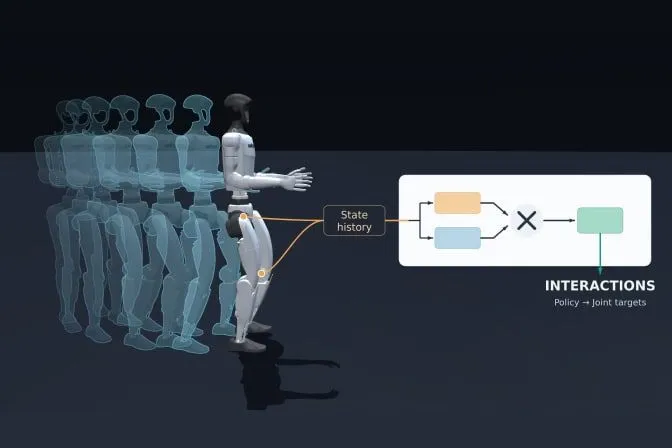
A neural network component learns physical interactions to help humanoid robots move and handle objects more reliably compared to larger conventional neural networks. Credit: Yu Laboratory, University of Michigan Engineering.
In simulated humanoid walking tests lasting 24 seconds per trial, PRISM achieved a 92.5% success rate, compared with 51% for conventional MLPs. Even after increasing the standard network's parameter count by approximately 43%, its success rate reached only 52.3%, suggesting that improved network architecture, rather than model size, drives the performance gains.
In a series of simulated walking tests, PRISM (bottom row) completed 92.5% of 24-second trials without falling while conventional neural networks (top row) only remained upright 51% of the time. PRISM continued to outperform previous methods when the physical conditions—like friction, mass or payload—changed without retraining or modifying networks. Credit: Yu Laboratory, University of Michigan Engineering.
PRISM also improved robotic contact control and recovery. In a simulated block-stacking task involving deliberately dropped blocks, the robot recovered and completed the task in 52.3% of trials, compared with 40.9% using conventional imitation learning. Notably, this was achieved without force sensors or an explicitly programmed compliance controller.
Real-world testing on a SO-101 robotic arm further demonstrated its potential. Using identical training demonstrations, PRISM achieved a 94% success rate in grasping a roll of tape across 50 attempts, compared with 68% for the conventional approach.
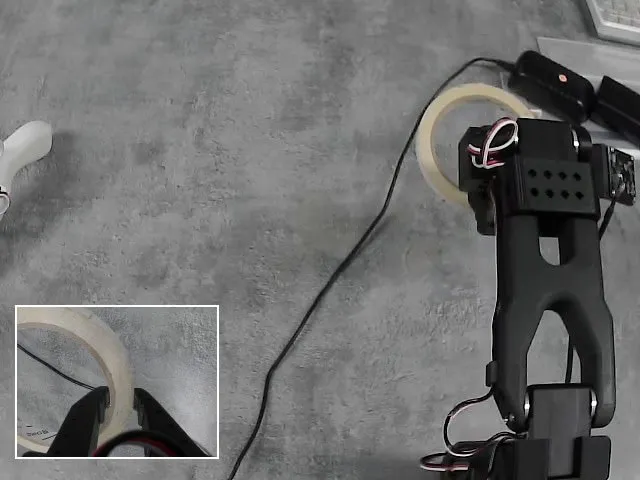
In a real-world testing where a SO-101 robotic arm was tasked with picking up a roll of tape, the new component—called PRISM (Polynomial Representations for Interaction-Structured Motor Control)—achieved 94% success across 50 attempts compared to only 68% for the conventional approach. Credit: Yu Laboratory, University of Michigan Engineering.
The system also showed greater robustness under changing physical conditions. Without retraining, PRISM achieved 92.3% success on flat ground versus 78.3% for a parameter-matched MLP, and 87.1% versus 80% on uneven terrain.
"Robot motor control is not an arbitrary mapping from observations to actions; it is governed by physical interactions," said corresponding author Stella Yu, a professor at the University of Michigan.
Although most results come from simulation and real-world validation remains limited to one grasping task, the research highlights a promising direction for physical AI, humanoid robots, and embodied intelligence. Rather than simply building larger AI models, designing neural network architectures that better understand physical interactions could be key to more reliable autonomous robot control.

