


Summary: Researchers at Colorado State University have developed a flexible, jointless robot based on tensegrity architecture. Inspired by an elephant’s trunk, it can bend, stretch, grasp objects and connect with other units to form rings, chains and branching structures, opening new possibilities for modular robotics, search and rescue, and space exploration.
Researchers at Colorado State University (CSU) have developed a new type of flexible robot that can bend, stretch and grasp objects without conventional mechanical joints. Led by Associate Professor Jianguo Zhao of the Department of Mechanical Engineering, the team built the robot using a structural design known as tensegrity. The research was published in Nature Machine Intelligence.
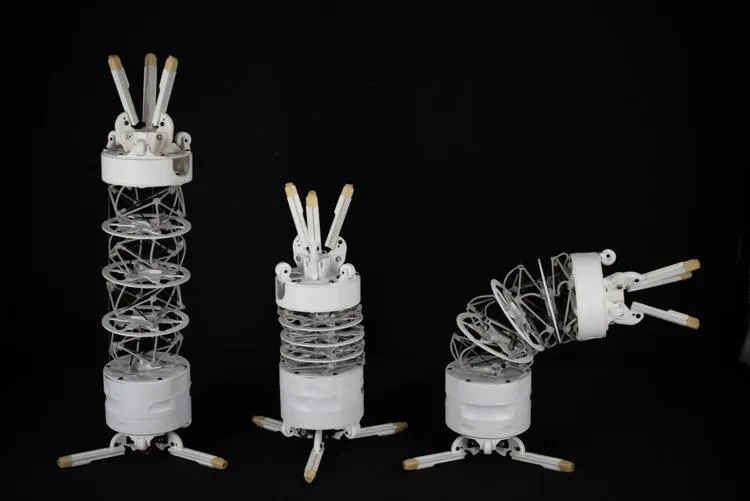
Researchers at Colorado State University have developed a flexible robot that functions like an elephant’s trunk to grip objects, with a goal of one day sending teams of these machines to aid in space exploration or to help with any number of other complex tasks. (Colorado State University Walter Scott, Jr. College of Engineer via SWNS)
Unlike conventional robots assembled from rigid components and mechanical joints, the new design uses rigid rods suspended within a network of pre-tensioned cables. By adjusting cable lengths and the relative positions of the rods, the tubular body can bend, collapse and extend while maintaining structural stability. Its movements resemble an elephant’s trunk or a tentacle rather than a traditional robotic arm.
The robot can wrap around and lift objects of different sizes, move across uneven terrain and perform coordinated docking. Mechanical grippers installed at both ends allow it to grasp objects and connect with other robotic units.
Reliable connections are particularly important for modular robotics. Magnetic coupling can become unstable under misalignment, external forces or vibration. The CSU design instead uses mechanical gripping to create more secure connections, allowing multiple robots to assemble into rings, chains and branching structures. This enables individual units to form larger configurations suited to different tasks.
One of the biggest engineering challenges was developing compact motors capable of fitting inside the tubular body while delivering multidirectional movement, sufficient torque and long-term reliability. Co-first author and doctoral researcher Mahmud Hasan Saikot said the team went through several design iterations and conducted extensive testing, including experiments on natural terrain beyond the laboratory.
The current system still requires human control for most operations, although researchers have demonstrated that two robots can autonomously locate each other and connect. The next goal is to coordinate dozens or even hundreds of units that can travel together, connect or separate as needed, and perform tasks with minimal human intervention. Improving movement speed is another priority.
If further developed, this jointless tensegrity design could support a new generation of reconfigurable robots for space exploration, search and rescue, and industrial operations, where adapting physical structure to unpredictable environments may be more valuable than optimizing a single robotic configuration.

